Academic articles on Chinese party-state politics
What is this database offering?
This database indexes all academic articles pertaining to Chinese party-state politics published by European scholars between 2017 and 2025. The catalogue includes hundreds of articles published primarily in English, as well as French and German. All articles concern one or more of the following topics:
- the political leadership system and the Communist Party’s membership, organisation, and its relationship with the state (government bureaucracy), the judiciary and courts, legislature, military and society;
- the relationship between central and local governments;
- the revival of Marxism-Leninism, dubbed Xi Jinping Thought, as the state ideology;
- the organisation, mechanisms and implications of Party-business relations ;
- the degree of Chinese society’s support of the political regime and its major policies;
- nationalism
Why did we decide to create this database?
The fundamental intention is to provide a permanently free online database to the policy community, researchers, and the general public of the EU. It aims to serve as a comprehensive and thematically organised library for European research on China’s party-state politics, placing European scholars and therewith shared European knowledge in focus.
What can the database be used for?
The database is a flexible tool for those interested in Chinese party-state politics. It can serve as a ready-to-use library, tailored according to the above-mentioned criteria through which users can filter to identify specific articles of interest. Furthermore, it can support students and scholars with literature reviews to grasp a sense of existing publications on their subject. The metadata associated with the database entries can be explored in the graphic insights published herewith.
Ultimately, we invite you to creatively use the database in your learning and research!
When was it created and/or updated?
The database was originally created in 2023 and updated continuously until the end of 2025.
Who is behind the database?
The database is developed and maintained by the China Horizons project, which is funded by the European Union's Horizon 2020 research and innovation programme. The database was produced by the Copenhagen Business School team in the China Horizons consortium.
Contact: Tove Duncan-Jones: This email address is being protected from spambots. You need JavaScript enabled to view it. (cc. This email address is being protected from spambots. You need JavaScript enabled to view it.)
Search

Search for document title
Catalogue
2017

This study examines the pro-democracy protests of Hong Kong in 2014 and how the protests became sites for Beijing’s representations of Chinese national image(s). It argues that ‘defensive soft power’ can be used to understand the process through which Beijing made such representations and projections. ‘Defensive soft power’, extending on Nye’s soft power is operationally defined as the reactionary activities taken in response to actions that harm or potentially harm a country’s national image. Based on an analysis of the data drawn from three mainland news media, several perceptions of China emerge - China as a victim; China as ‘reasonable’ power; and China as benign and tolerant leader in the China-Hong Kong relation. This research highlights the ‘Umbrella Revolution’ as an instance where ‘defensive soft power’ was used to (1) fend off negative national images and (2) project positive national images. Mapping out the process of national image defence will enable readers to better understand a sovereign state’s strategies to defend attacks on and promote positive perceptions of its national image.
Party-State Structure and Governance
Measurements of Chinese political trust may be inaccurate due to ‘refusal bias’, resulting from unwillingness of people with certain attitudes to take part in surveys. Such bias is especially problematic because researchers usually have little or no information about refusers. Nevertheless, techniques have been developed which allow correction of refusal bias by extrapolating from reluctant or difficult respondents on the basis of various measures of response propensity. Using data from a nationwide survey conducted in China in the winter of 2012/13, this article shows that this type of correction procedure improves the accuracy of measurement of the Communist Party membership rate, and produces significantly lower estimates of trust in the central government/Party leadership, trust in local government and support for the current system of government. Refusal bias is likely to result from the social desirability of expressing political trust and support under authoritarian conditions
Society's Support
This article examines the role of participatory governance innovations in China. The purpose is twofold. First, it seeks to explore the logic and dynamics behind participatory innovations in China. Second, it examines in what way a participatory innovation in Hangzhou can lead to increased accountability and responsiveness of the local government. Participatory innovations in China are used as a way to improve the Party-state’s governing capability and thereby strengthen the legitimacy and power of the Communist Party. Despite some limitations related to the evaluation of politically powerful Party and government departments, social assessment of government performance in Hangzhou serves as an input channel from society that put pressure on many government departments. The study finds that by allowing limited and controlled political participation, transparency and accountability to develop, the reform in Hangzhou improves the responsiveness of the political system.
Central-Local Relationship
Based on a questionnaire survey in five counties of Ya’an Municipality in south-western China, the study reveals a fairly high level of political trust among citizens. The study also confirms the disparate trust in different levels of government known from other studies, i.e. that political trust in the central government is higher than political trust in local governments. The contribution of this research is a fine-grained investigation into the sources of local political trust in the municipality under scrutiny. More precisely, the analysis shows that political trust in local governments is associated with both cultural factors and perceptions of the quality of local government. Particularly, political trust in local governments is strongly influenced by the perception that these governments perform well, are responsive to citizens’ needs, and are free from corruption.
Society's Support
Party-State Structure and Governance
In this article, we examine the administrative functions that have been carried out by social organizations (SOs) in China since 2013. We use evidence from Guangdong to demonstrate that the transfer of authority to SOs is selective, tends to create more burdens for local government, and generally does not lead to greater autonomy for SOs. [...] The evidence from Guangdong permits us to conclude that the transfer of authority to SOs allows for innovations in public administration, but that politics continues to motivate government decisions as to which functions are suitable for SOs to undertake, casting doubt on the ability of the Chinese Communist Party to achieve sustainable improvements in local governance and public service provision.
This paper is the first to investigate the changes in criteria for market access under China's Qualified Foreign Institutional Investor (QFII) Programmes. By combining insights on institutional change and Chinese elite politics, it demonstrates that the evolution of access criteria can be explained by interdependent bargaining between Chinese party leaders, administrative authorities and corporate interests. The 2008 global financial crisis triggered fundamental shifts in resource interdependencies that altered the bargaining dynamics between these agents. The changes in internal and external conditions are decisive for understanding how the QFII programmes evolved. The analysis draws on an original data-set coupling 91 multi-stakeholder interviews, database analysis and internal government records. The findings show that institutional change in China's cross-border investment programmes is a negotiated economic outcome bridging interdependent state and market agents. These results have important implications for the study of globalisation and institutional change in non-Western contexts. They challenge existing narratives of an all-pervasive Chinese party-state that is resistant to change.
Ideology
Xi Jinping's rise to power in late 2012 brought immediate political realignments in China, but the extent of these shifts has remained unclear. In this paper, we evaluate whether the perceived changes associated with Xi Jinping's ascent – increased personalization of power, centralization of authority, Party dominance and anti-Western sentiment – were reflected in the content of provincial-level official media. As past research makes clear, media in China have strong signalling functions, and media coverage patterns can reveal which actors are up and down in politics. Applying innovations in automated text analysis to nearly two million newspaper articles published between 2011 and 2014, we identify and tabulate the individuals and organizations appearing in official media coverage in order to help characterize political shifts in the early years of Xi Jinping's leadership. We find substantively mixed and regionally varied trends in the media coverage of political actors, qualifying the prevailing picture of China's “new normal.” Provincial media coverage reflects increases in the personalization and centralization of political authority, but we find a drop in the media profile of Party organizations and see uneven declines in the media profile of foreign actors. More generally, we highlight marked variation across provinces in coverage trends.
Party-State Structure and Governance
This article examines the so-called “central State Owned Enterprise (SOE) problem” in China's environmental governance system, namely central SOEs' defiance of environmental regulation. [...] We argue that a combination of “central protectionism” of state-owned national champions and insufficient regulatory capacity in the environmental bureaucracy have provided state firms under central management with both incentives and opportunities to shirk on environmental regulations. Yet, while the institutions of central protectionism are deeply rooted, countervailing forces within the complex Chinese state are also gaining momentum. In spite of the considerable regulatory challenges, officials in the environment bureaucracy display increasing resolve and ingenuity in trying to strengthen their enforcement capacity.
While it was traditionally accepted that Hongkongers shared a form of pan-Chinese cultural identification that did not contradict their local distinctiveness, over the last decade Hong Kong has seen the rise of new types of local identity discourses. Most recently, “localists” have been a vocal presence. Hong Kong has – quite unexpectedly – developed a strong claim for self-determination. But how new is “localism” with respect to the more traditional “Hong Kong identity” that appeared in the 1970s? The present study takes a two-dimensional approach to study these discourses, examining not only their framework of identification (local versus pan-Chinese) but also their mode of identification (ethno-cultural versus civic). Using three case studies, the June Fourth vigil, the 2012 anti-National Education protest and the 2014 Umbrella movement, it distinguishes between groups advocating civic identification with the local community (Scholarism, HKFS) and others highlighting ethnic identification (Chin Wan). It argues that while local and national identification were traditionally not incompatible, the civic-based identification with a local democratic community, as advocated by most participants in recent movements, is becoming increasingly incompatible with the ethnic and cultural definition of the Chinese nation that is now being promoted by the Beijing government.
Ideology
This article explores the changing dynamics between gender, cultural capital and the state in the context of higher education expansion in contemporary China. [...] The findings from the survey study suggest that singleton status might mediate the impact of socioeconomic status and cultural capital on students’ academic performance and elite opportunities. [...] The most significant finding is concerned with singleton girls’ strategy of applying for Chinese Communist Party membership as a way to minimize their social and gender disadvantages. I argue that there emerges a bottom-up approach of women empowerment through qualifications and political selection during China’s transition. Political selection is dressed up in seemingly meritocratic selection, thus becoming more appealing to female undergraduates who, in turn, take advantage of party membership to add a silver lining of political loyalty to higher education qualifications.
Ideology
The 19th Congress of the Communist Party of China was held in Beijing October 18-24 2017. Leading up to the congress there was intense speculation concerning the new line-up of the most important leadership bodies of the CPC: the Politburo and the Politburo Standing Committee. Would the Politburo Standing Committee (PSC) continue to consist of seven members, or would it be expanded to nine members, as was the case during Jiang Zemin's era, or would it instead be reduced to five members, as was the case during the late 1980s? [...] Xi Jinping's report to the Party congress was also awaited with muchinterest. Such a report is usually a long document setting out the Party'spriorities and policy objectives for the next five-year period. Would XiJinping's report signal new policy initiatives, and would it outline strategic guidelines reaching beyond 2022? This article examines these questions and assesses the future impact of the Party congress on Chinese politics.
Drawing on a database tracking the career of 1,250 top Chinese executives from 1,084 publicly-listed state-owned enterprises (SOEs), this article analyzes differences in career incentives for subsidiaries controlled by the central government compared to those controlled by local governments. It also considers the differences for executives in listed companies close to the parent group compared to those that are heads in distant subsidiaries. We find that in both SOEs and their publicly listed subsidiaries, administrative experience or political connections appear to increase the likelihood of promotion. However, in the case of central SOE subsidiaries, leaders are more likely to be promoted based on financial performance. For both central and local 'direct' SOE groups age is a significant negative factor for promotion, whereas tenure is a significant positive factor.
Due to the particular political reality under the Party-state, neither a substantial nor a formal way is sufficient to grasp the key problem confronting the Chinese rule of law, namely the separation of the Party and the state. This article argues that the precondition for rule of law in the Chinese Party-state lies in the paradox thesis: How and to which extent the separation of the Party and the state within a Party-state is possible and, more importantly, in which sense such a separation is achieved. The author argues that, when under the political reality of Party-state, the kind of Party-state separation in the organizational sense is not realizable in a foreseeable future, the Party-state separation in the functional sense as the basic space should be upheld and maintained, if man can still argue that some kind of rule of law in China exists or is still needed.
Party-State Structure and Governance
Emerging economies such as China enjoy economic expansion, but also face dramatic environmental challenges. China's government is a central actor in both stimulating economic activities and pursuing environmental protection. Drawing on panel data and in-depth interviews, we examined the influence of the Chinese state at multiple levels on the environmental actions of publicly listed firms. The results show that corporate environmental actions follow an inverted U-shape as control of environmental practices moves from the central government to the most decentral administrative level. This curvilinear relationship is positively moderated by the stringency of environmental regulation and negatively moderated by environmental monitoring capacity. We conclude that state influence on corporate environmental actions in China is multifaceted and subject to “policy-policy decoupling.”
Recent literature on environmental governance in China frequently ascribes blame for China's environmental problems to sub-national governments' lax environmental enforcement. Such research implicitly assumes that more central control would lead to better results but, as yet, the role of the centre in environmental governance remains underresearched. In the context of the current phase of recentralization, this article studies central and local interests, capacities and interactions across policy issues and government agencies. By “bringing the centre back” into the study of central–local relations in China, we examine both where such recentralization has in fact occurred and whether such recentralization efforts have improved environmental outcomes. We argue that centralization does not improve outcomes in every case. Further, central and local levels of governance are not as different as they might seem. Indeed, there are significant areas of overlapping interests and similar patterns of behaviour, both positive (enforcement) and negative (shirking), between central and local administrations. The results draw an empirically and theoretically rich picture of central–local relations that highlights the innate complexity of China's environmental governance patterns during the current phase of recentralization.
Central-Local Relationship
Party-State Structure and Governance
This article defines the key parameters of ‘state entrepreneurialism’ as a governance form that combines planning centrality and market instruments, and interprets how these two seemingly contradictory tendencies are made coherent in the political economic structures of post-reform China. Through examining urban regeneration programmes (in particular ‘three olds regeneration’, sanjiu gaizao), the development of suburban new towns and the reconstruction of the countryside, the article details institutional configurations that make the Chinese case different from a neoliberal growth machine. The contradiction of these tendencies gives room to urban residents and migrants to develop their agencies and their own spaces, and creates informalities in Chinese urban transformation.
Party-State Structure and Governance
One of the main drivers of China’s e-commerce boom is the dramatic expansion of the country’s Internet finance industry, which has grown and diversified at a staggering rate over the past decade. The emergence of Chinese Internet finance has been discussed in largely positive terms as facilitating commercial activity. [...] This article challenges this dominant narrative of beneficial digital financial inclusion in China. [...] The article argues that these examples illuminate fundamental processes implicit in the expansion of the commercial Internet finance industry. In this way, while the extension of digital financial inclusion in China benefits certain groups, it also necessarily serves to reproduce patterns of inequality and exploitation.
Party-State Structure and Governance
China is equipping itself with a mid-long-term strategy to sustain its manufacturing sector in the face of potential challenges brought about by “disruptive” technologies. [...] In China, scholars, state officials, and the entrepreneurial community have profoundly analysed the impact that disruptive technologies can exert on their firms’ role in the global value chains, reaching the conclusion that the country has to frame a policy to hedge that risk. This paper aims to provide an overview of the debate stirred up by the confrontation of the national manufacturing sector with the introduction of new technologies. The debate, which has involved many institutional and economic actors, has influenced the industrial plans recently drawn up by the Ministry of Industry and Information Technology (MIIT).
Illustrated by a case study on the urban development of a medium-sized city in China, this article develops a theoretical framework to help understand the role the financial system plays in the urban development model based on land in China. Three fields of literature have been used in order to link the various mechanisms between land, urban infrastructure, property development, and financing channels in urban production. The case study illustrates the many interactions between local government and real estate businesses, both state and private, as well as local banks, in order to create urban infrastructure that responds to “communal and public” needs and real estate objectives of a “private and individual” nature. In doing so, it highlights the fundamental role of capital in urban production in China.
Ideology
The paper seeks to enrich the discussion of China’s power by critically engaging with existing literature on the topic, presenting a conceptual analysis of power, and suggesting a framework for future research. [...] It is argued that the main fault of the existing literature on China’s power is confusion surrounding the concept of power. [...] In this place, the article argues that an exhaustive assessment of state power should contain an analysis of state’s intentions, its sources of power on (at least) three analytical levels, and outcomes of interactions. Thirdly, an analysis of Chinese policies in the South China Sea is offered as an example of applying the framework to a concrete issue. Finally, the article identifies further directions for researching China’s power and foreign policy using the presented model of power.
Nationalism
Party-State Structure and Governance
Under the slogan of “new normal” (xin changtai) the PRC has started to revise its governance model. This new mode of governing the Chinese party-state is based on synchronized reforms in five sectors, coordinated via a “top-level design” (dingceng sheji). While the market is ascribed a leading role for the allocation of resources, reforms also include a modernization of the state bureaucratic system. Furthermore, new frames have been added to the PRC’s official governance philosophy that indicate a turn to a novel concept of state-society relations.
Party-State Structure and Governance
The reforms initiated in the wake of the decisions taken at the Third Plenum in 2013 have been accompanied by a reconfiguration of political rhetoric. This paper argues that the narratives and slogans surrounding China’s proclaimed entrance into the era of “new normal” economic development reflect the plurality of ideas and definitions of governance prevailing within the country’s academic communities. When drafting new policies, China’s political leaders can cherry-pick and compile reform packages that synthesize these groups’ core demands and theory-based developmental roadmaps. The concepts and policy ideas put forward by the fifth generation hence stand for a fragile balance between continuity and change, while seeking to define a new working consensus between the various subgroups of influential elites both inside and outside the party apparatus.
Ideology
This paper highlights how much the notion of governmental innovation is closely related to the idea of incremental transformation of the political system and to the strengthening of the Party-state’s capacity to govern as well as to its legitimacy.
Nationalism
""In this issue, we examine the specific characteristics of Chinese speech, public opinion and political participation, as well as the consequences of their growing interaction with the outside world, whether in China, on the internet, while travelling, in the context of their studies or professional lives, and the strategies they adopt to express their opinions and participate.""
Catalogue
2018
Ideology
This article explores the prominent features of China’s state-led campaign of cultural diplomacy. Through multiple comparative case studies of its flagship project of the Confucius Institute (CI), it aims to identify and contextualise the various variables affecting its effective operation. It finds that this dependent variable is mainly determined by the independent variable of the CI’s ability to localise its product and process to suit different target audiences, along with a number of extraneous variables, including ideology, nationalism and the media environment in the destinations. People-to-people interaction is also an important mediator that contributes to facilitating mutual understanding. All the variables and the complexity of their inter-relations constitute the Chinese characteristics and are charted out in a diagram.
Central-Local Relationship
This article examines the design, implementation and reception of defense education in Chinese universities. Delivered by the People’s Liberation Army since 1985, this program, which aims at cultivating students’ civic awareness through elementary military training, is still ongoing today. Official publications and interviews with students who attended the training suggest that defense education is successful in conveying the authority of the Party-state to China’s new elite youth. The physical component of the training is the added value that is well received by the new generations, by comparison with ideological indoctrination. The Chinese Communist Party’s use of the military to infuse discipline and compliance among a historically volatile section of society highlights the militarist nature of the People’s Republic of China.
Nationalism
This paper examines the concept and practice of meritocracy in Chinese national oil corporations’ (NOCs) graduate recruitment and selection. It focuses on the post-2008 NOC reform period, which sees NOCs place increasing rhetorical emphasis on meritocratic or ‘fair’ recruitment and selection. However, this paper argues that, in practice, these sentiments remain unrealized. The NOCs continue to use some sub-optimum applicant assessment measures and misuse or misunderstand the more optimum ones. Likewise, the prioritization of certain criteria, such as elite education, has merely advantaged graduates with strong Bourdieu capitals. Hence, this produces a flawed meritocracy that neither maximizes fairness nor efficiency, but strengthens elitism. Moreover, its capacity to serve political interests is questionable too. These insights, then, enhance existing academic debates over China’s engagement with meritocracy.
Party-State Structure and Governance
Ideology
This article traces the process of Xi Jinping’s campaign in 2012–2017 and explains how an anticorruption effort has been transformed into an exercise of power-consolidation for his office. The findings of this article are three-fold. First, the power-consolidation process has benefited from a combination of an ideological campaign and a disciplinary campaign, which were not only synchronized but also feed into one another to achieve a shared goal. Second, the campaign became politicized around midterm and intensified afterwards. The pace of progress of the campaign coincided with Xi Jinping’s advancement of power. Third, the most significant outcome of Xi Jinping’s campaign is not the numbers of disciplined corrupt officials but the paradigm-change in the disciplinary regime of the Party: first, the reversal of the depoliticization process of the Party’s disciplinary regime; second, the retention of temporarily mobilized anticorruption resources; and third the simplification of evidence production procedure. The combined result is a considerable expansion of the CCDI’s anticorruption investigative capacities and a significant increase Xi Jinping’s leverage to impose political loyalty and compliance upon Party officials in the future.
Ideology
Central-Local Relationship
Previous research has credited China's top leaders, Hu Jintao and Wen Jiabao, with the social policies of their decade in power, arguing that they promoted these policies either for factional reasons or to achieve rational, problem-solving goals. But such arguments ignore the dominant “fragmented authoritarian” model of policymaking in China that centres on bargaining among bureaucratic agencies. This article asks whether top leadership factions, rational problem solving, or “fragmented authoritarianism” can explain the adoption of one of the Hu and Wen administration's flagship policies, New Rural Cooperative Medical Schemes. [...] The article highlights some of the effects that China's international engagement has had on policymaking and the need to go beyond explanations of the policy process that focus solely on domestic actors. It proposes a new model of policymaking, “network authoritarianism,” that centres on policy networks spanning the domestic–international, state–non-state, and central–local divides, and which takes account of the influence of ideas circulating within these networks.
Party-State Structure and Governance
Society's Support
On China's web, networked actors ranging from state agencies to private Internet users engage in highly active online discourse. Yet as diverse as this discourse may be, political content remains highly regulated, particularly on issues that affect the legitimacy of the ruling party. A prominent issue in this regard has been modern Chinese history, particularly the “national humiliation” that Japan inflicted on China's populace during events like the 1937 Nanjing Massacre. This article asks how the discourse on this particular event is structured on China's web, and what such practices of digital “remembering” can tell us about nationalism in the information age. Combining content analysis and digital tools, the article shows how the mass-media model that the Chinese authorities and various commercial actors apply to the web ultimately reproduces the very logic of “imagined communities” that makes reconciliation of historical disputes in East Asia so protracted.
Central-Local Relationship
This article seeks to understand how reported mediation rates in Chinese courts are produced and what they actually signify. It analyzes data obtained through prolonged fieldwork at a court in central China. The article finds that the court has directly responded to central level mediation incentives by enhancing its overall mediation rate. It has done so strategically by seeking the highest increase using the fullest discretion in the mediation incentive structure and seeking to optimize the highest rate at the lowest cost and risk to the court. This has undermined the objectives of the central level incentives toward mediation, while also drawing the courts' scarce resources away toward unnecessary mediation practices, in part far removed from the courtroom. The article concludes by drawing out broader theoretical conclusions about how information asymmetries, discretion, and goal displacement play out in hierarchical control structures of authoritarian courts.
The Hu–Wen era has been characterized as a “lost decade” for economic and political reform, but a “golden era” in terms of economic growth and political stability. Yet, relatively little attention has been paid to the social policies introduced during Hu and Wen's decade in power. These important policies, however, abolished agricultural taxes, extended health insurance, pensions and income support to almost all rural as well as urban residents, and built a civic welfare infrastructure to address migrants’ grievances. [...] Although Hu–Wen era social policy reforms had only limited effects on reducing income inequality and involved complex politics, they did establish for the first time entitlements to social security and safety nets for all China's population.
Society's Support
Nationalism
Guided by Michel Foucault's concept of “pastoral power,” this article examines the ways in which contemporary discourses within official narratives in China portray the state in a paternal fashion to reinforce its legitimacy. Employing interdisciplinary approaches, this article explores a number of sites in Urumqi, the regional capital of the Xinjiang Uyghur Autonomous Region (XUAR), in order to map how a coherent official narrative of power and authority is created and reinforced across different spaces and texts. It demonstrates how both history and the present day are depicted in urban Xinjiang in order to portray the state in a pastoral role that legitimates its use of force, as well as emphasizing its core role in developing the region out of poverty and into “civilization.”
This article examines Chinese civil–military relations using a bottom-up analytical approach and hitherto untapped sources, including interviews with military personnel in active service. It argues that traditional approaches to political control, which generally interpret the changing political–military relationship through military professionalism and institutional autonomy, miss out on important aspects and may generate erroneous conclusions. Here, focus is instead on the professional autonomy of the Chinese officer corps. Through an empirical study of the organization of military work at two of China's top military education institutes, the article illustrates how professional autonomy and direct political control vary, both between hierarchical levels and issue areas. This highlights the multidimensionality of both control and professional manoeuvrability and underlines the fruitfulness of including an intra-organizational perspective in order to reach better informed conclusions about political control and civil–military relations in today's China.
Party-State Structure and Governance
Party-Business Relations
China's government is promoting new-type think tanks. [...] In China's case, this is a powerful one-party state undergoing internationalization: usually understood as increased foreign exchanges, engagement with international institutions, and rising influence globally. In contrast, I view internationalization as the reorganizing of China's state institutions and social structure in order to integrate with the global capitalist system. [...] Drawing on interviews with Chinese think-tank scholars, and examining policy debates on the development of think tanks in Chinese academic and policy journals, I argue that the sphere of think tanks has become an important site of political contestation concerning China's internationalization and the impact of class power on national policy making. Western observers, too often viewing independence as the key criterion for evaluating China's think tanks, miss the significance of these debates. The relations between think tanks and government institutions must be understood in this political context.
Society's Support
This article studies post-2000 Chinese feminist activism from a generational perspective. It operationalises three notions of generation— generation as an age cohort, generation as a historical cohort, and “political generation”—to shed light on the question of generation and generational change in post-socialist Chinese feminism. The study shows how the younger generation of women have come to the forefront of feminist protest in China and how the historical conditions they live in have shaped their feminist outlook. In parallel, it examines how a “political generation” emerges when feminists of different ages are drawn together by a shared political awakening and collaborate across age.
Ideology
Central-Local Relationship
The Communist Party of China (CPC) is not withering away as predicted by some Western scholars. On the contrary, in recent years, the party has centralised and strengthened its rule over China. At the same time, party membership has changed. [...] This article discusses how the CPC has evolved from a mass to an elite party. It argues that in this process, the party has taken over the state resulting in a merger and overlap of party and government positions and functions, thereby abandoning Deng Xiaoping’s ambidextrous policy goals of separating party and government. Centralisation and reassertion of ranking-stratified party rule is Xi Jinping’s answer to the huge challenges caused by the economic and social transformation of Chinese society—not a return to Mao’s mass party.
In February and March 2018 the 3rd Plenum of the 19th CPC Congress and the first meeting of the 13th National People's Congress (NPC) were held. During these meetings, important and far-reaching structural reforms were adopted, including constitutional amendments, restructurings of the government and the relationship between Party and state. Structural reforms are common at the outset of a new fi ve-year NPC term, and it is important to understand these reforms as part of an ongoing process. The recent reforms, however, were remarkable in the way they rearranged Party–state relations and bolstered not only the Party but, importantly, Xi Jinping's authority as core leader. This article provides a detailed overview of the major changes in constitution, government structure (ministries and state departments), personnel and Party authority.
Ideology
Western political scientists, regarding China as a nation-state like any other, commonly classify it as a ‘party-state’ and as ‘authoritarian’. Yet China’s transition to modern statehood differed from that of almost every other postimperial or ‘new’ nation on the planet. Drawing on new scholarship in the history of empire and of modern China, this essay reflects on certain repercussions of the Sinic world’s singular experience of empire, imperial breakdown, and passage to political modernity. What light, we ask, can reexamining China’s oddly intact transfiguration—from dynastic empire to people’s republic—shed on how the Party has governed since 1949? With a view to tailoring an altered research agenda for political scientists today—one better fitted to grasping what Chinese authorities may mean when they refer to building ‘socialism with Chinese characteristics for a new era’—we consider, in particular, several techniques of governance associated with empire relating to scale and strategy, to hierarchy and differentiation.
Ideology
The Chinese Communist Party is confronted with a growing gap that separates the rhetoric about socialism and party rule from the individualism and materialism caused by capitalism and opening up to the outside world. In response, the Party has developed strategies that draw on an understanding of the dedication to the Party that is specifically religious, yet does not require belief, conviction, or faith in a doctrine. These strategies revolve around the Leninist concept of ‘party spirit’, which, paradoxically, has been turned into a commodity that can be produced, supplied, and consumed. Drawing on insights from the anthropology of pilgrimage, tourism, and religion, this article discusses these strategies in the context of party cadre education and so-called ‘red tourism’. The article concludes that the Party is shaping its evolution from an infallible bearer of ideological dogma to a sacred object of worship as part of a new ‘communist civil religion’.
Ideology
Research suggests that over the last two decades China has undergone dramatic changes in its communication climate. The former mono-glossic environment has made way for a plurality of voices, now debating (non-sensitive) political, social and economic issues on online fora. [...] This paper examines the various strategic narratives that cumulatively constitute this ‘China story’, designed for the international as well as domestic audiences. It looks into divergences/convergences with the political discourse of previous generations of leadership by examining argumentation patterns and discursive strategies used in speeches and texts produced by top-level officials and their ‘core’ leader, Xi Jinping.
Society's Support
Nationalism
In the current research on media and communication, Western internet companies (e.g. Google and Facebook) are typically described as digital platforms, yet these actors increasingly rely on infrastructural properties to expand and maintain their market power. Through the case study of the Chinese social media application, WeChat, we argue that WeChat is an example of a non-Western digital media service that owes its success first to its platformization and then to the infrastructuralization of its platform model.
Nationalism
Party-State Structure and Governance
The ideology, propaganda, and political discourse of the Communist Party of China (CPC) have continued to function as key elements of the political system of the People’s Republic of China (PRC) in the post-Maoist period since 1978. [...] Furthermore, it is often no longer possible to differentiate between the CPC’s internal and external propaganda, as seemingly exclusively domestic ideational and discursive issues increasingly correlate with international phenomena. However, the trends in the Xi era do not present paradigmatic shifts, but rather an overall reassertion-cum-innovation of previous Maoist and post-Maoist uses of ideology, propaganda, and political discourse, primarily aiming at strengthening one-party rule.
Ideology
After decades of double-digit economic growth, China experienced a significant drop in GDP growth rates in the wake of the global financial crisis. For the new Chinese leadership under Xi Jinping, who had assumed power in the fall of 2012, analysts predicted a looming crisis due to the alleged decline in the regime’s performance legitimacy. This article argues against a mechanistic application of the notion of performance legitimacy. Instead, it proposes to take into account the role of ideology in mediating public perceptions of regime performance. By tracking the career of the concept of “new normal” in Chinese public discourse over a period of three years – from late 2013 to late 2016 – it shows how the economic slowdown has been framed in ways conducive to the reproduction of regime legitimacy. The findings suggest an intense process of ideological contestation and decontestation, in which the domestic reflection of foreign audiences and their recognition of the Chinese regime’s performance have gained in importance.
Nationalism
After 1978, Maoism as a living mass ideological and social force in the People’s Republic of China largely died away. The Party state’s legitimacy since that time has been based on a new pillar of economic competence and the delivery of tangible economic gains. But China is still a place where, at least within the political elite, there is an identifiable ideology and associated language that links the aims of a political force, the Communist Party of China, with national prosperity, historic rejuvenation, and the delivery of the political goals promised when the Communist Party was founded almost a century ago – modernity in Chinese society. Ideology has not disappeared in this interpretation. It has just become more concealed, more nuanced, and in some spaces more flexible. For Chinese contemporary leaders, ideology is partly a body of practices, beliefs, and language which have been bequeathed to them by previous leaders, and which show that they are part of the same historic movement that runs from 1921 to 1949, and through 1978 until today. This body of practices is aimed at maintaining a sustainable system of one party rule, as well as an assertion of discipline and control in the core tactical spaces of political power. Under Xi, a group of twelve keywords maps out the discursive space that matters to the CPC today. These terms exemplify the ways in which the contemporary CPC is willing to use ideas from diverse sources, either from its own past, or from classical Chinese thinking, as a means of achieving emotional as well as intellectual impact, and to assist in the delivery of the major Party goal of the twenty-first century – the creation of a great nation with the CPC at the heart of its governance. Underlying the keywords and the ideological space they define is the larger notion of the Party, not just attending to material but also spiritual needs – and creating not just a wealthy country, but also a spiritual socialist civilization.
Ideology
Nationalism
The central role of ideology has been one of the key features of the political system of the People’s Republic of China (PRC) since 1949. One of the places where the phenomenon can be observed is the Xinjiang Uyghur Autonomous Region, a vast, important, and rich borderland area inhabited by some 10 million Turkic Muslim Uyghurs. Since 1949, the central government has managed to win only a limited degree of Uyghur support for its policies, leaving the region riven with protest and violence. The central government has therefore sought to devise and implement policies so as to simultaneously address multiple aspects of Xinjiang’s reality, including ideational affairs. This paper examines the party-state’s ideational governance, i.e. efforts to define and regulate Uyghur values, beliefs, and loyalties so that they are instrumental in maintaining the political stability of the PRC. [...] The conclusions reached in this article raise the broader question as to whether the party-state’s resolve to strengthening its ideational governance over the Uyghurs will bring about a change in the security situation in Xinjiang.
Central-Local Relationship
Society's Support
The role of elites and their policies in the process of regime transformation are not as simple as “rule by the people” implies, once it is recognized that all “real-existing democracies” depend crucially on the role of representatives who act as intermediaries between the citizens and their rulers. Instead of rule by a few vs. rule by all, we have “rule by some politicians” as the outcome. These newly empowered representatives inevitably form an elite institutionally separate from the electorate that has chosen them competitively or the selectorate that has chosen them for their reputation.
This paper intends to provide a framework for conceptualizing and interpreting the resilient capacity and adaptability of the Chinese Communist Party to cope with changing political and economic environments and to sustain its hegemony through periods of crises and transformations. Based on an instrumental reading and reflective incorporation of some relevant concepts and discourses of Gramsci’s political theory, the paper aims to facilitate a well-rounded analysis of the CCP’s authoritarian resilience, which is achieved through a continuous process of “passive revolution”. The party’s new hegemony is realized through a reconstituted historical bloc on the basis of convergence of interests and through neutralizing the pressures of various contending forces that might otherwise trigger profound structural transformations. The paper concludes that “authoritarian resilience is one of the strongest enduring features of the CCP’s political culture, characterized by dynamic adaptive skills and greater institutional capacity for political survival.
Ideology
This article offers an analysis, from a legal point of view, of the status of Chinese political parties and their respective roles in the system of “multi-party cooperation and political consultation under the leadership of the Communist Party of China.
Nationalism
Party-State Structure and Governance
""Beijing continues to rely on forms of censorship and self-censorship that condition Chinese public discourse and stipulate that it be perfectly sleek and harmonious. This strategic dimension is likely to be well-received by foreign leaders and nationals. At the same time, these Twitter accounts permit conversations to begin and give a human face to the Chinese superpower.""
Party-State Structure and Governance
Nationalism
""The ""socialist rule of law with Chinese characteristics"" aims at strengthening a rulebased governance, but still adheres to the basic structure of the constitutional model of Marxism-Leninism. Core of this model is the postulate of a historical mission. Today this mission calls to realize the ""Chinese Dream"" of the ""Rejuvenation of the Chinese Nation"" in the shared interest of mankind. As for the Communist Party of China, this mission legitimizes its claim to leadership. The consequential concept of law shapes the entire Chinese legal system.""
Catalogue
2019
Central-Local Relationship
This article draws on analysis of local policy documents and migrant and official interviews to explore the development, implementation and impacts of two aspects of China’s 2014 hukou reforms that have been less scrutinised than the abolition of the rural/urban distinction: the mandatory use of residence permits and points systems for migrants to cities with a population over 5 million. Taking migrant education as a case study, and focusing on Shanghai, Shenzhen, and Beijing, it argues that central and local priorities are more about population control than social equality. Far from their stated aims of equalizing migrant services with locals, the policies introduce new forms of educational and social stratification, aimed at increasing control over migrant selectivity, with far-reaching consequences for Chinese social development.
Central-Local Relationship
Party-Business Relations
Past studies agree that the efficiency and effectiveness of policy experimentation is highly context dependent. This study examines how policy pilots are used as tools for implementing China’s energy transition and how this has produced mixed results. While pilots have effectively mobilized actors to rapidly expand renewable power generation, efforts to integrate renewable energy into power grids have been unsuccessful. The article shows that the central government uses policy pilots as an end in itself rather than as a means for future scale-up. Instead of using them as tools to bring about systemic change, the central government applies pilots as instruments of state signaling and coalition building. This promotes local protectionism and hinders coordinated efforts to achieve the envisioned sustainable energy transition.
This article shows how China became a global competitor in the railway- and construction equipment industry by using a combination of defensive and offensive mercantilist policy tools. While many scholars in IPE have recognized that economic state intervention is still commonplace, the literature focusing on economic nationalism has failed to grasp its multifaceted feature. By confusing economic nationalism with protectionism, the possibility of outward-looking measures within a mercantile strategy has been neglected. The research that does recognize the ability of states to combine global economic integration and continued market intervention, demonstrates an empirical bias towards strategic emerging industries and state-owned enterprises. This article includes the role of offensive economic policy measures as well as less strategic sectors and private- owned enterprises in China’s mercantile strategies.
Ideology
The author puts forth an analytical framework called party-state realism for understanding how policy makers in the People’s Republic of China approach foreign policy. It has four defining characteristics. In order of importance, they are: putting the interests of the Communist Party at the core of China’s national interest calculation; and on this basis adopting an instrumentalist approach; adopting a party-centric nationalism; and adhering to a neoclassical realist assessment of the country’s place in the international system and its relative material power in advancing national interest. In this conception, the putting of the Chinese Communist Party’s interest at the core of national interest is a constant, not a variable, factor. This does not mean the changing international context and relative national power are irrelevant, just that they take secondary importance.
Central-Local Relationship
Society's Support
By scrutinizing the semantics of words and going beyond a nominalist approach, this article compares the theoretical, linguistic and discursive evolution of the notion of representation in France and China, from its ancient origins to its contemporary interpretations. We argue that the word “representation” in English and “dàibiǎo 代表” in Chinese are not interchangeable synonymous, because “representation” includes a symbolic dimension that is absent in dàibiǎo, and because the latter is rarely used when informal representation is concerned. [...] Such argument refutes the current understanding of representation as a “one-way authorization” that is supposed to come either from below (i.e. from the people) in the electoral democracies or from above (i.e. from the state authority) in authoritarian regimes and thus challenges the over-simplistic dichotomy of democratic and authoritarian regimes in representative studies.
Central-Local Relationship
Society's Support
The Chinese People’s Political Consultative Conferences (CPPCCs) tend to be disregarded in scholarly work for lacking formal political powers. This overlooks the fact that the CPPCC has a range of embedded input functions for the Chinese Communist Party (CCP), including the task of reflecting popular opinions and social issues (反映社情民意fanying sheqing minyi). This article looks closer at this aspect of the CPPCC, drawing on interviews, internal documents, and publicly available information. The findings highlight the complex relationship between officially defined purpose, top-down control, and local practice of reflection-work. Despite the divergence between expressed and intended goals, in practice, this form of CPPCC-work can both be a way to engage CPPCC-members in solving issues of local governance, as well a channel for, broadly defined, political inclusion at the local level in China.
Party-State Structure and Governance
Society's Support
This article examines the so-called “grid governance” scheme, a widely used grassroots governance strategy implemented in urban China in recent years. Drawing on data collected in multiple cities from 2011 to 2016, it analyses in what ways, and to what extent, the state employs the grid governance scheme to resolve neighbourhood conflicts and reinforce governance in Chinese urban middle-class neighbourhoods. The findings highlight complex interactions under the scheme among the residents, the state and market actors in neighbourhood governance, including the resident volunteers, residents’ social groups, residents’ committees and property management companies. By coopting middle-class resident volunteers, maximizing the existing political influence of the retired urban elites, and establishing Party organizations in middle-class residential communities, the grid governance scheme has become a major vehicle for resident mobilization and conflict resolution, and a key governance mechanism to reinforce the Party's leadership in middle-class neighbourhoods.
Party-Business Relations
Within the debate of China’s rise and its implications for the liberal order this research focuses on China’s global posture through its transnationalizing firms and capital. [...] The article finds substantial transnational linkages between the globalizing Chinese business elite and the corporate elite networks of Western globalized capitalism – through corporate affiliations and policy-planning affiliations. At the same time the analysis reveals the strong ties of the Chinese state-business elites to the party-state. Rather than presenting an outright threat to the liberal order and the corporate elite networks at its core, or indicating a co-optation scenario, the article finds evidence for a more hybrid scenario in which China as a corporate actor within the liberal world reveals its two faces: partially and pragmatically integrating and adapting to the liberal modes of networking, while simultaneously holding on to its distinctive state-directed capitalism and the (Party) direction this entails.
Ideology
More than a whole cycle of the chinese zodiac has elapsed since the special issue of Social Research, ""China in Transition,"" was published in 2006. After 12 years, China's transition is not towards democracy but towards a kind of neo-totalitarianism. During this period, Liu Xiaobo, who had written in that issue on the growing influence of civil society, was awarded the Nobel Peace Prize and died in prison, while his wife was placed under house arrest for almost a decade. The year 2008 was a watershed, as the financial crisis dealt a serious blow to the Washington Consensus, while the successful organization of the Olympic Games by Beijing impressed the world. The Chinese leadership used this opportunity to become more assertive on the international scene, presenting its regime as a credible alternative to Western democracy and the market economy that had led the world to an unprecedented crisis. Liu Xiaobo's dream of a strong civil society capable of putting an end to the Communist Party's dictatorship has vanished.
Party-State Structure and Governance
Society's Support
How is Xi Jinping changing the course of China’s rise? Based on a Gramscian analytical framework inspired by Bob Jessop, this article provides an anatomy of Xiism (2012–) as an emergent hegemonic project, that is, a (fallible and contested) attempt by China’s party-based power bloc of altering global power balances in China’s favour while retaining domestic stability. Through juxtaposition with Maoism (1957–76) and Dengism (1978–2012), it is proposed that Xiism reformulates the power bloc’s strategy in three respects.
Party-State Structure and Governance
The practice in Leninist political systems of assigning local leaders concurrent seats on higher-level leadership bodies presents a puzzle. In China, for example, a subset of provincial leaders hold seats in the central Politburo, while some city-level leaders hold seats in provincial party standing committees (PPSCs). [...] Through analysis of an original dataset on PPSC appointments and case studies of three Chinese cities, we show that concurrent appointments in China’s provinces can function as a means of concession, compromise, or co-optation, but we find little evidence that concurrent appointments allow higher-level authorities to firmly control or economically exploit localities.
Party-State Structure and Governance
Nationalism
Following a series of high-profile attacks in Beijing, Kunming and Urumqi by Uyghur militants, the Chinese party-state declared a “war on terror” in 2014. Since then, China's Xinjiang region has witnessed an unprecedented build-up of what we describe as a multi-tiered police force, turning it into one of the most heavily policed regions in the world. This article investigates the securitization of Xinjiang through an analysis of official police recruitment documents. Informal police jobs, which represent the backbone of recent recruitment drives, have historically carried inferior pay levels. Yet, advertised assistant police positions in Xinjiang now offer high salaries despite low educational requirements, thereby attracting lesser-educated applicants, many of whom are ethnic minorities. Besides co-opting Uyghurs into policing their own people, the resulting employment is in itself a significant stability maintenance strategy. While the known numbers of violent attacks have subsided, China's heavy-handed securitization approach risks alienating both minority and Han populations.
Society's Support
Ideology
How can a weak organization be a path to power? The Chinese Communist Youth League (CYL) lacks autonomy and coherence yet it is seen as the cradle for one of the main factions within the Chinese Communist Party (CCP). To understand this tension, I provide a novel account of the role played by the CYL in the recruitment of leading cadres since the 1980s. Against explanations based on factional struggles, I argue that the rise of CYL-affiliated cadres is a by-product of the organization's weakness. As the Party appoints CYL heads, CCP leaders, at various levels and at different points in time, have used the League to accelerate the promotion of their protégés. For years, there has been little incentive for Party bosses to dismantle this promotion path. However, in his bid to consolidate his power, Xi Jinping has weakened this channel so that it may not be used by potential rivals.
Party-State Structure and Governance
There is among Chinese international relations scholars an intense debate about how China can protect and promote Chinese global presence and interests while at the same time continue to adhere to the principle of non-intervention. New concepts, distinctions and approaches are developing as the debate progresses. The current Chinese foreign and security policy practice reflects a more flexible and pragmatic Chinese interpretation – and implementation – of the principle of non-intervention with different degrees and types of intervention. This article explores the search for “legitimate great power intervention” characterizing both the debate among Chinese international relations scholars and the current Chinese foreign and security policy practice, and uses this case as the departure point for a more general discussion of the drivers of change – and continuity – in Chinese foreign and security policy.
Nationalism
The Communist Youth League has developed a network of sub-organisations to expand its reach at minimum cost. It exemplifies the low-cost corporatism model. Following this model, mass organisations maintain a corporatist relationship with the Party while diversifying their activities through structures they supervise. These structures also provide them with additional material and human resources. In this configuration, the Communist Youth League maintains an equilibrium between dependence on the Party and attractiveness to young people. However, reforms put forward under Xi Jinping challenge this fragile equilibrium by strengthening Party control over the League and its sub-organisations.
Central-Local Relationship
Society's Support
Like other socialist institutions surviving in China’s market reforms, the All-China Women’s Federation (ACWF or WF when referring to its local branches), as the only state-sponsored organisation representing women’s interests, has been constantly refashioning itself to meet new existential challenges. [...] Drawing from extensive fieldwork in three provinces and a neo-institutional analysis, this article argues that in the short term, although the reform serves principally as a consolidation of Party authority, local Women’s Federations are creatively using the reform to expand their popular base and broaden their representativeness. In the long term, however, local WFs are facing unreformed institutional problems such as political marginalisation, bureaucratisation, and ineffective implementation, which stagnate further development of China’s state feminism.
This article, the product of several years of extensive fieldwork, seeks to reinvigorate the debate on China’s private entrepreneurs by arguing that they have become a “strategic group” within the Chinese polity. While they do not openly challenge the current regime, they continuously alter the power balance within the current regime coalition, which connects them to the party-state at all administrative levels. As the future of Chinese socialism depends on the sound development of the private-sector economy and, therefore, on the promotion of private entrepreneurship, it can be expected that entrepreneurial influence within the regime coalition will rise, with inevitable consequences for regime legitimacy and stability.
Ideology
Corruption has been linked to urgent transnational problems, including, inter alia, market uncertainties, the undermining of democracy, economic disparity, religious extremism, and authoritarianism. As corruption is a global problem, it requires coordination across states’ anticorruption laws. Anticorruption thus provides grounds to reassess the promise and limits of transnational law. [...] The Article argues that lawyers’ roles are a lynchpin of these overlapping systems of compliance as their work operates to discipline corporations in China; nonetheless, lawyers’ position in the global legal market impacts what they deem to be “corrupt” and which rules apply. A focus on cross-border lawyers as transnational communities thus marries legal analysis with a contextual grounding in lawyers’ work, an approach that has merit for the study of comparative law more generally. The Article finds that given market pressures, in the area of anticorruption, trends show a preference for “bicultural lawyers,” those who are both embedded within transnational communities and respond to demands in the global market.
Party-State Structure and Governance
Society's Support
The Chinese People’s Political Consultative Conference (CPPCC) system is a curious institution: often ridiculed as a decorative “flower vase” for the one-Party regime, or, at best, a networking club meant to appease elite groups, it does not attract much scholarly attention. The Communist Party leadership, however, clings adamantly to what it says is a “broadly representative” intermediary body helping with policy reform and United Front work. In this article, we investigate the validity of this original logic with the help of fresh empirical data. We look at the CPPCC’s institutional history, principles of member selection, delegates’ self-conceptualisation, and their modes of operation. Intermediation, it appears, has always been a blurry task for CPPCC members, resulting in a wide array of behavioural choices – from parroting of the Party line to attempts at proactive agenda setting. After more than two decades of relative openness to innovative bottom-up policy proposals, new rules of unified conduct now again stifle the consultative potential of the CPPCCs – but there seems to be some room for intermediary agency left, especially at the local level.
Central-Local Relationship
Society's Support
This article examines intermediary governance space in China’s urban neighbourhood governance. [...] In the context of relocation communities, this article examines: how residents’ committees are put into place to carry out governance tasks; in what ways the land-losing farmers organise themselves and are mobilised to adjust to a new residential environment, and to what extent conflicts of interest are moderated within the neighbourhoods. The findings suggest dynamics of emerging intermediary governance space and actors in relocation communities. Performing as the liaison between the Party-state and the relocated villagers, the intermediary actors and organisations employ flexible practices and strategies in negotiating the relations between the state, the market, and the citizens produced through neighbourhood governance affairs.
Party-State Structure and Governance
This review essay analyzes the literature dealing with Xi Jinping’s anticorruption campaign. It identifies two major debates in the literature that see the campaign either as an inner-Party power struggle or as a genuine attempt to deal with the problem of corruption and organizational issues the Party is facing. In a second step, the review essay links these two understandings to larger trends in the understanding of the Chinese Communist Party in the literature. These understandings focus either on elite politics and theories of factionalism or connect to the larger debate on the decline versus resilience of the Party. It concludes that different understandings of Xi’s campaign are not mutually exclusive but adopt different points of focus and are rooted in different debates on the Chinese Communist Party.
Ideology
Making sense of the Chinese policy process has been one of the most challenging endeavors for China scholars since the beginning of ‘reform and opening up’. Although a great deal of empirical knowledge has been gathered over the years on policy-making and implementation in many different fields, theorizing on the Chinese policy process has mostly been concerned with individual policy instruments or various modes of policy-making so far instead of looking at how these are interconnected. In this article, we propose ‘political steering theory’ as an integrative theoretical framework to fill in this gap. Originating from policy research conducted by German social scientists starting in the 1970s, we consider ‘political steering theory’ to be the most appropriate approach to the Chinese case, particularly in the current era of ‘top-level design’ led by Xi Jinping. We demonstrate how China recently recalibrated its political steering approach and propose new directions for research into the Chinese policy process under the current administration.
Society's Support
The Chinese authorities are currently struggling to transition towards a sustainable socio-economic system. The assertion of Chinese power abroad may therefore be seen as an attempt to shift the excesses of its own development model onto the populations of other countries.
Ideology
""Some academics have tried to make comparative studies of economic reforms in China and the former Soviet bloc. The history of Communist societies in Europe has thus remained a reference mark for thinking about politics in China since 1989.""
Ideology
The 1989’ movement originates in three crisis: intellectuals’ claims about their position within the elite, factional struggles for power, and mobilization of civil society. They are still at work in today’s Chinese society.
Central-Local Relationship
Society's Support
The Ram Union is a non-profit social organisation established in 2003 in Zhejiang Province. Its transformation from a local entity into an international NGO tells us about the methods implemented by the Chinese Communist Party (CCP) to accompany the development of popular associations or minjian, which appear to be external to the Party but which in fact are fully sponsored by it.
Ideology
Central-Local Relationship
Drawing on an institutionalist theoretical framework and data from key speeches and documents on reform decisions, our analysis discovers an approach to reform that heavily relies on overriding dysfunctional state structures by formalizing and constitutionalizing ad-hoc (informal) institutional arrangements. [...] These findings suggest that reform politics under Xi Jinping are not to be conceived of as just another cycle of temporary adaption but rather as directed towards a transition to a new stage in the Chinese state-building process, which also indicates the emergence a new sub-type of hybrid regimes.
Catalogue
2020
Central-Local Relationship
How does the elevated threat of protests during sensitive periods affect state repression in a high-capacity authoritarian regime? Drawing on a dataset of over 3,100 protests in three Chinese megacities, this study provides three key findings: first, the frequency of protests before and during national-level focal events and subsequent to national-level disruptive events is depressed, suggesting preemptive repression is taking place. Second, the likelihood of responsive repression is marginally reduced before and during local-level focal events and slightly elevated after national-level disruptive events. Third, contention is intensified when local political elites meet. Sensitive periods do not bring contention to a standstill and costly bursts of responsive repression were not observed. Stability maintenance during times of increased regime-vulnerability was thus less rigid than often assumed.
Central-Local Relationship
Why do China’s authorities repress some protests, but not others? By how much do crowd size, violent tactics and protest location increase the likelihood of repression? Based on a newly available dataset of more than 70,000 protest events collected from social media, this article tests three competing explanations of protest repression in China. It finds that repression is closely correlated both with the cost of concessions for local governments and protest intensity. A small-scale and peaceful labor protest in an urban locality very seldom encounters repression, but rural riots against land grabs, evictions or environmental pollution are nearly certain to experience state-sanctioned violence or arrests even if the number of participants is low.
Ideology
This article analyzes changing patterns of leadership with a special focus on the re-centralization and re-personalization of Chinese politics as initiated under Xi Jinping. Going beyond the categorization of personalistic rule, it argues that the construction of visionary, futuristic governance ideas—as illustrated by the opening of Xiong’an New Area in 2017/2018—are part of a transformational leadership mode. Xiong’an is constructed as a test lab for Chinese AI innovation and a model city unit of green urbanization, illustrating the political leaders’ will to engage in all-encompassing reforms. By framing Xiong’an as a presidential signature initiative, potential risks and implications for the party-state’s long-term regime legitimacy, in case of unexpected delays or implementation complications, are reduced to a minimum.
Ideology
Society's Support
What has China learned from the ‘Century of Humiliation’? In China’s mnemonic practices, ‘the backward will be beaten,’ which attributes the nation’s humiliation experiences to economic, military, and technological backwardness, is the most significant ‘lesson from past’ required to be remembered. Bridging the literatures on memory, nationalism, and International Relations (IR), this study conducts a detailed analysis of the making of ‘the backward will be beaten’ and examines how it helps shape China’s perception of national security based on a competitive worldview and its associated nationalist visions. This study also identifies alternative discourses that challenge the dominant historical lesson by intellectuals and netizens. It contributes to a nuanced understanding of the collective memory of the Century of Humiliation and its implications for Chinese nationalism and foreign relations.
Party-State Structure and Governance
In this paper I conduct a comparative analysis of three Chinese experiments with participatory budgeting (PB), a democratic innovation that has circulated worldwide. Relying on a renewed typology of political representation and ethnographic fieldwork combined with official data collection in Chengdu, Sichuan and Wenling, Zhejiang over seven years, it investigates the expansion and practice of PB and analyzes the relationship between participation and representation. It asserts that in the Chinese context PB cannot be simply reduced to empowering civil society against established representatives or becoming an instrument of legitimization for established elites. In the three investigated cases—which are not representative of Chinese local politics—PB does contribute to opening the decision-making process to formerly excluded participants, who are nonetheless not exactly ordinary citizens but rather local elites and “super residents” bridging the gap between established elites and residents.
Society's Support
This paper proposes a new agenda for research on Chinese politics that overcomes the obscuring effect of the ubiquitous ‘party-state’ construct, finds a substantive place for the Chinese Communist Party (CCP), and thereby reveals dynamics of the interplay between the Party, society and state that otherwise remain hidden. [...] We show why, in conceptualizing and theorizing this one-party state’s state-society relationship, it is imperative to separate ‘Party’ from ‘state,’ to bring the former under close scrutiny, and to do so in a way that accounts for the multidimensional, multidirectional interplay between state, society and Party. [...] By doing so, we offer examples of the dimensions and dynamics of governance processes, such as tensions between Party and state imperatives, the implications of Party reliance on the state to influence society, and the possible spaces for actor agency that, without this proposed shift, go ignored or misinterpreted.
Society's Support
This article explores the relationships among neoliberalism, social policy expansion and authoritarian politics in contemporary China. It argues that in the era of neoliberalism, rising new right and authoritarian governments, the Chinese Communist Party has sought to retain power by shifting politically to the right and promoting neoliberal-looking economic policies. These policies have raised average living standards but also increased insecurity for most of the Chinese population, while new social policies have facilitated marketization. [...] These social policies’ most significant dark sides thus include compounded income inequalities and the segmentation and stigmatization of the poorest. Authoritarian controls have enabled the Communist Party to avoid redistributive policies that would undermine its urban support, so that politics in China differ from the right-wing populism of new, anti-establishment authoritarian regimes.
Party-State Structure and Governance
In spring 2018 China, indignant popular nationalists demanded that the “spiritually Japanese” activities of a fringe group of young Chinese who figure themselves as Japanese be proscribed. The National People's Congress quickly complied, passing legislation that made it illegal to “beautify the war of invasion.” Exploring how and why the Chinese Communist Party (CCP) responded to the demands of popular nationalists, we suggest that authoritarian representation occurs in China even beyond the bounds of everyday apolitical issues like education and healthcare. Indeed, because the CCP relies upon a nationalist claim to legitimate rule, authoritarian legislators may respond to the public on politically sensitive issues like nationalism as well. Journalists and lawyers, furthermore, can play a vital mediating role between elites and masses, facilitating the transmission of the information and expertise needed for authoritarian responsiveness. Implications for our understanding of Chinese nationalism, authoritarian responsiveness and state legitimation in China today are discussed.
Nationalism
Society's Support
This paper offers a critical and historical analysis of the transformation of citizenship in China in a way that challenges both legal orientalism and the overall discourse on Chinese “characteristics” and “exceptionalism”. It aims to uncover how citizenship has been transformed “structurally” (Solinger 1999) as well as through “acts of citizenship” (Jakimow 2012). The paper will therefore not only look at how the One Party State defines citizenship, uses it as an instrument of repression and population control, but also how citizens themselves can contribute to a new narrative on citizenship and driver of contestation in China. The paper will argue that the transformation of citizenship has contributed to the reinforcement of the fragmented and transnational nature of Chinese citizenship.
Party-Business Relations
It was widely assumed in the West following the collapse of European socialism that China would undergo a similar process of counter-revolution. This article seeks to understand why, three decades later, this hasn’t happened, and whether it is likely to happen in the foreseeable future. The article contrasts China’s “reform and opening up” process, pursued since 1978, with the “perestroika” and “glasnost” policies taken up in the Soviet Union under the Gorbachev leadership. A close analysis of the available data makes it clear that China’s reform has been far more successful than the Soviet reform; that, in contrast to the Soviet Union in the 1980s, all the key quality of life indicators in China have undergone significant improvement in the last 40 years, and China is emerging as a global leader in science, technological innovation and environmental preservation. The article argues that the disparate outcomes in China and the Soviet Union are the result primarily of the far more effective economic strategy pursued by the Chinese government, along with the continued strengthening of the Communist Party of China’s leadership.
Society's Support
Nationalism
The SOE (state-owned enterprise) sector provides an important avenue to political power in China. A number of SOE executives are members of the Central Committee of the Communist Party of China (CPC) and often they change career tracks to become leading government and Party officials. In the past, the oil and gas sector was a significant recruitment basis for government and Party leaders. However, in recent years, the aerospace sector has become more dominant. This is a result of the anti-corruption campaign which has, in particular, targeted the oil sector, and also reflects the emergence of new sectors and social groups due to changing political and socio-economic conditions of Chinese society. The oil and gas industry is an old industry associated with China's heavy-industrial growth model of the past, whereas aerospace represents China's technological future.
This paper proposes a new agenda for research on Chinese politics that overcomes the obscuring effect of the ubiquitous ‘party-state’ construct, finds a substantive place for the Chinese Communist Party (CCP), and thereby reveals dynamics of the interplay between the Party, society and state that otherwise remain hidden. Since the 1980s, the state-society relationship has been the subject of extensive scholarship. Yet most such work treats the CCP as little more than the assumed and elusive source of power behind the state. We show why, in conceptualizing and theorizing this one-party state’s state-society relationship, it is imperative to separate ‘Party’ from ‘state,’ to bring the former under close scrutiny, and to do so in a way that accounts for the multidimensional, multidirectional interplay between state, society and Party. We combine a historical perspective with analysis of political documents and discourse to demonstrate how research toward this new agenda might be pursued. By doing so, we offer examples of the dimensions and dynamics of governance processes, such as tensions between Party and state imperatives, the implications of Party reliance on the state to influence society, and the possible spaces for actor agency that, without this proposed shift, go ignored or misinterpreted.
Party-State Structure and Governance
Ideology
Since taking office, president Xi Jinping’s government has granted massive funding to what has become China’s strongest poverty-reduction campaign ever. Based on the study of detailed budgets in eight rural counties, as well as ethnographic and interview data in a ninth county, this article explores how poverty alleviation programs shape the distribution of power and resources in rural China. It argues that poverty alleviation in rural China predominately focuses on infrastructure investment and support to the local economy, rather than on social insurance, education, and household subsidies. Support to local companies, the article argues, entails co-opting established enterprises, rather than supporting new entrepreneurship among poor households. Overall, the Chinese approach to rural poverty alleviation highlights the emergence of a state-sponsored corporate paternalism that strengthens local hierarchies of wealth and power.
The paper aims to address the development of China’s narrative power during the COVID-19 pandemic and its impact on world order. It argues that in the post-pandemic world, the emergence of the authoritarian sub-order would be prompted by China’s more proactive narrative power, given that the climate of opinion is ambiguous when faced with the uncertainty of the pandemic. [...] China has been building its narrative along with its changing strategic diplomacy – from restrained and low-profile to proactive and assertive. In the conclusion, some reflections on China’s narrative power and the implications for world order are considered.
Nationalism
Ideology
Slogans (fixed or authoritative formulations, 提法) are ritually repeated elements in Chinese politics, appearing in strategic documents and main speeches. Building on new institutionalism in Political Science, this paper systematically introduces and conceptualizes the phenomenon of slogans. While slogans have been approached from the perspective of linguistics or (political or cultural) history and have often been dealt with partially or implicitly, the paper addresses a gap in studying slogans from the point of view of Political Science. I argue that they are an integral part of China’s political system, playing a role of a crucial organizational feature, whose significance goes far beyond a mere behavioural regularity, replicating a centuries-long Chinese tradition of officially orchestrated language to support a ruling regime.
Society's Support
Party-State Structure and Governance
This article investigates China’s use of strategic narratives to facilitate its geopolitical return, through a critical case study of the Belt and Road narrative’s effects on foreign policy formulation in the Netherlands. [...] By connecting elements of the narrative with co-optive processes found to occur within three subnational cohorts (business, media ecology, and foreign policy establishment), it highlights that Western countries may be more susceptible to non-coercive Chinese influence than is conventionally thought. In terms of a theoretical contribution, the article demonstrates that a decentred and outcome-oriented approach to narratives like the Belt and Road may enhance understanding of the mechanisms underlying China’s ability to use rhetorical strategy to tilt political battlefields to its favor.
Society's Support
""[...] Chinese workers' strikes have seen a significant increase since China's integration into the global economy. [...] It also shows how solidarity with these struggles is necessary to change the fate of the working class, not only in China but also in the rest of the world.""
Nationalism
Hongkong’s judiciary independence has been more and more disputed by the imperative to restore Chinese sovereignty, exemplifying the primacy of political security over the rule of law in China.
Society's Support
China is establishing a social credit system aimed at evaluating each Chinese citizen according to how well he or she obeys and conforms to the rules and ideals of the Chinese Communist Party. The system could well rely on data handled and collected through artificial intelligence. Odd though it might seem, public opinion appears to be in favor of this tool for social engineering.
""This article draws a broad portrait of the Chinese space-related universities and the academic background of the Chinese space leadership. It then discusses the attractiveness of space companies vis-a-vis other tech sectors, the flows of talent between state-owned and private companies, and the impact on compensation.""
Party-State Structure and Governance
""In a context where the party-state often aims to erase Protestantism from the public sphere, churches [...] tend to stage their own disappearance. [...] This article first examines the overarching presence of the state in the Protestant space. It then focuses on the adaptation of churches to these political constraints and their reactions to the new 2017 religious regulations.""
""The Covid-19 outbreak initially caught China’s party-state off guard. He then mobilized and further strengthened all the social control techniques at his disposal, in order to curb the threatening pandemic. But, on social networks, part of the population is letting its frustration emerge with the restrictions imposed on information and initiative. Increased control and more assertive frustration portend developments whose course remains unpredictable.""
In this article, we analyze the main types of and possible reasons for structural changes in the central government apparatus in China over the past 70 years. We find interesting patterns of structural change in line with administrative developments.
Central-Local Relationship
This article tries to looker closer, apart from the adaptation process of such a population, into the role of the local government and how its administration influences the lives of international residents. The analysis would allow us to better understand how the local Chinese governments are receiving international residents, especially in small cities when the international community might prove to be more important to the local one.
Society's Support
Emmanuel Dubois de Prisque takes another look at the SCS here, showing how this system—inspired by Western practices for assessing the ability of economic actors to repay their borrowing—has wormed its way into the daily lives of Chinese citizens. He highlights the aims of the Chinese leaders in this connection (in particular, to promote virtuous human behaviour and trust), and the extent to which these are entirely consistent with China’s long cultural and political traditions
Society's Support
China hasn’t anticipated the epidemic, because of the politicization of public health and of the bureaucratic structure of the Party-State. But these very ressources have paradoxically enabled it to contain the epidemic afterwards, giving autoritarian policies of the regime some credit.
Using China as an example, the article raises the question of the extent to which the rapid development of the economy is also forcing the legal system to differentiate itself from the political-administrative sphere and examines the consequences when the autonomy of the legal system is blocked from party politics and administration.
Nationalism
Society's Support
The Law of the People’s Republic of China on Safeguarding National Security in the Hong Kong Special Administrative Region (Security Law) highlights the shortcomings of the 1984 Sino-British Joint Declaration and the inherent conflicts of the “one country, two systems” principle. The arrangement has always been full of contradictions and grey areas. With the Security Law, the Chinese leadership has created facts on the ground. The move comes at the expense of civil liberties and accelerates the spread of socialist legal concepts in Hong Kong.
Catalogue
2021
Nationalism
The mass publicity of court decisions in China, this article argues, is part of the larger trend of the Chinese judiciary becoming increasingly centralized. The transparency reform enables the Supreme People’s Court to control the information reporting process within the judicial hierarchy and rein in local courts through public scrutiny. Interestingly, local courts responded strategically, making disclosure far poorer than required. Meanwhile, the central government has dispatched more cadres to local courts, and these cadres are associated with more than a 10 percent higher disclosure rate of judicial decisions, suggesting that centralization of personnel is adopted to effectively implement the centralized policy. The transparency reform, coinciding with reforms in other domains, embodies an important shift toward a more centralized judicial sector in China.
Central-Local Relationship
Party-State Structure and Governance
How do Chinese provincial governments reformulate the general central policies into implementable local policy outputs? How does this vary across provinces? Despite considerable research on policy implementation in China, strategies of policy reformulation remain understudied. To better understand these strategies, this article proposes a four-scenario typology: an innovative strategy, a defensive strategy, a conservative strategy, and a perfunctory strategy. Using a novel 2003–2017 dataset of provincial documents that were reformulated from central social policy mandates, as well as a preliminary case study of the Household Registration System reform, this article explores the spatial and temporal dynamics of policy reformulation in provincial China. The findings shed light on the complexity of policy implementation in China.
Ideology
Increasingly, policymakers, observers and scholars are calling for including China in nuclear arms-control efforts. Missing from debates, however, is a thorough analysis of Chinese perspectives. Drawing extensively on Chinese-language sources, this article traces the evolution of arms-control views among Chinese strategists and experts during the last decade. Updating earlier scholarship, we find that most Chinese strategists tend to view arms-control efforts through a strongly realpolitik prism. Many lament US domination of the arms-control agenda and believe US initiatives are intended to undermine Chinese nuclear deterrence. In recent years, these views have hardened. Chinese strategists increasingly see arms control as an arena for zero-sum military and political struggle.
Ideology
Since the mid-1990s, the operational doctrine of the People’s Liberation Army (PLA) has increasingly focused on jointness. For two decades, however, the PLA’s organizational structure did not adapt accordingly. A major reform was eventually passed in 2015, with the establishment of a new joint operational command system. This 20-year institutional lag is explained by the changing pattern of civilian intervention in military affairs. Even more than doctrinal change, organizational change is likely to be met with resistance from within the military. A facilitating role is then played by civilians who provide external support to pro-reform senior military officers. Yet, such external support depends on the state of civil–military relations, which determines the room for civilian intervention in the military sphere.
Central-Local Relationship
Society's Support
Political representation centers on who claims to represent what and the extent to which the audience feels being represented. The mainstream body of scholarship on political representation has focused on electoral-based representation in the context of liberal-democratic settings. [...] This article seeks to address the question of how do the Chinese authorities enhance political representation by public deliberation in social welfare policy? [...] It reveals that the party regime has developed an increasingly sophisticated set of strategies in establishing representation by deliberative consultation. Furthermore, two distinctive forms of deliberative representation, the state-authoritative model and the light-empowered model can be discerned from the different deliberative participatory experiences of Guangxi and Hubei. The deliberative elements introduced into the poverty alleviation program demonstrate that with a deeper and more consequential engagement of the citizens in welfare policy decision making, there can be an empowered form of political representation generated even in a non-electoral setting.
Party-Business Relations
How public policies change incrementally over time remains understudied. This paper contributes to the studies of incremental policy change by integrating the theories of policy layering and learning into a theoretical framework of experimental governance (EG). Using a mixed research method, we apply this framework to process-tracing the changing trajectory of China’s central government infrastructure public-private partnership (PPP) policies from 1988 to 2017 by looking at evolving policy goals, policy measures, and policy co-issuing networks. Results suggest that China’s central government infrastructure PPP policy change follows a refined EG approach in which policies change incrementally in a layering pattern, primarily driven by learning. Findings provide a new account of incremental policy change.
Party-State Structure and Governance
Ideology
Leading cadres in China are subject to rotation. An interesting form of rotation takes place between big business and the political world. That means one fifth of China’s governors and vice governors have a business background as heads of one of China’s large State-Owned Enterprises (SOEs). How this takes place and which qualifications the involved business leaders possess are shrouded in mystery. Based on prosopographical studies of Chinese business leaders who have participated in the Chinese Executive Leadership Program (CELP), this article attempts to open the black box. The study examines the career pathways of CELP participants in Party, government and business positions. The study shows that 84 of the 261 CELP SOE participants (2005-2018) were subsequently promoted, and 20 of these promotions were from SOEs to leading Party and government positions. In some cases, former business leaders became Party secretaries in important provinces or ministers in key ministries. The article also argues that Chinese business leaders have managed to keep their administrative ranking in the Chinese nomenklatura system. In fact, Chinese business leaders are quasi officials (zhun guan) and form an important recruitment base for leadership renewal. As such, the article suggests that the rotation of cadres within the ‘Iron Triangle’ of Party–government–business constitutes the main unifying and stabilising factor in the Chinese political system.
Party-State Structure and Governance
Central-Local Relationship
Trilemma situations, which have long been the subject of lively discussion in economics in many fields, indicate risks of instability and unsustainability. This article shows that China has also been facing a political-economy trilemma (and thus the ongoing danger of unsustainability of its development strategies) for 70 years now and has reacted differently to it in different eras. The article distinguishes three epochs: the Mao era (1949–1978), the Deng era (1979–2011), and the Xi era (2012–). It argues that in all three epochs basically the same main objectives were pursued (economic growth/convergence; stability; and the maintenance of a one-party communist rule system), but with different priorities and with different instruments. It is shown that the Mao- as well as the Deng-development strategies related to these goals ultimately failed due to increasing systemic imbalances. Now the question arises whether the Xi strategy, which relies on partly new instruments, namely the nationalism map, the BRI program and digital surveillance, will be better able to control the unsustainability threat hidden in the trilemma. In addition, the article discusses possible strategy alternatives to overcome the trilemma problem.
Party-State Structure and Governance
Democratic centralism, a hallmark of Leninist party organizations, has played a formative role in the history of the Chinese Communist Party (CCP). Yet despite being hailed as an “inviolable” and “unchanging” Party principle, understandings of democratic centralism have shifted dramatically over the century of its existence. This study traces the long arc of the concept's evolution across successive Party Constitutions, focusing on three critical historical junctures: the Sixth Party Congress, which formally adopted democratic centralism into its Constitution as an organizational principle; the Seventh Party Congress, which adopted rectification as the Party's practice of democratic centralism; and the 19th Party Congress, which set a new milestone in codifying the system as a disciplinary tool. I argue that while democratic centralism exemplifies the CCP's institutional plasticity and adaptive governance and is critical to understanding Party-driven constitutionalism in contemporary China, it also highlights an irresolvable paradox inherent in Party rule. Adaptability does not necessarily impart resilience. I conclude that the CCP's normatively unconstrained extra-constitutional leadership under Xi Jinping highlights the essentially and increasingly irrationalist aspects of its illiberal governance project.
Ideology
This forum article aims to question the polysemy of China's “wolf warrior public diplomacy”. This expression not only explains China’s current efforts in foreign affairs and the transition of its diplomatic communication strategy from a soft, defensive, and convergent tone to a progressively harsh, offensive, and aggressive one but also allows Beijing to manage and employ nationalist public opinion at the domestic level through the creation of a heroic image in order to disseminate a vision of Chinacentrism, even a Chinese chauvinism. “Wolf warrior” contains a serious nationalist sentiment that provides mechanisms and conditions for the Communist Party of China to maintain its dominant power in Chinese society and conquer discursive power on the international stage.
The Chinese Communist Party (CCP) is a closely constituted party. Recent studies of the CCP describe and evaluate its formal rules, but to understand the Party as an institution we also need to understand its informal rules. The literature on “party norms”, “institutionalization” and the “unwritten constitution” often fails to distinguish rules from other political phenomena. It confuses informal rules with political practices, constitutional conventions, behavioural equilibria and doctrinal discourse. It is prone to overlook important rules, and to see rules where there are none. Hence, it potentially overstates how institutionalized the CCP is, and therefore how resilient it is. The article provides a clearer account of informal rules and suggests a different explanation for the resilience of the CCP.
Nationalism
This article explores how trust affects the nature and characteristics of civic engagement among university students in contemporary China. We draw upon empirical evidence from in-depth individual interviews involving 68 students born between 1993 and 1999. [...] Generalised trust amongst university students seems to be low, but they do exhibit unquestioned trust in the State. The organisations with which they associate either are top-down through the Communist Party, which is ideologically narrow and socially distant among the members, or promote geographical origin-based bonding rather than bridging relationships. Our findings add new depth to our understanding of the relationships between the dominant modalities of trust and the typical form of civic participation in Chinese universities.
Society's Support
Nationalism
Authorities in the People’s Republic of China communicate with citizens using an estimated 600,000 Sina Weibo microblogs. This study reports on a study of Chinese citizens’ adoption of microblogs to interact with the government. Adoption results from trust and peer pressure in smaller-network ties (densely knit, pervasive social networks surrounding individual citizens). Larger-network ties (trust in institutions at large, such as the Chinese Communist Party, executive organizations, the judicial system, the media, etc.) are not associated with the adoption of microblogging. Furthermore, higher levels of anxiety are correlated with lower levels of use intention, and this finding underlines the impact of the Chinese authority’s surveillance and control activities on the lives of individual Chinese citizens. Based on these findings, we outline a theory of why citizens use microblogs to interact with the government and suggest avenues for further research into microblogs, state–citizen communication patterns and technology adoption.
Nationalism
The discussion on Chinese cultural heritage started to emerge as a result of inspiration coming from foreign travels of Chinese scholars-officials and as protective measures against looting of artifacts in the 19th and 20th centuries. The most spectacular robberies were carried out by Anglo-French forces in the Old Summer Palace (Yuanming Yuan) during the Second Opium War in 1860. That event became one of the cornerstones of the “century of humiliation” (bainian guochi) in the Chinese historical narrative. Even though the Communist Revolution classified historical sites as remnants of feudalism, today the Communist Party of China has assumed the role of a defender of the Chinese heritage. In contemporary China, its cultural heritage is a phenomenon of both domestic and international significance. The Chinese emphasize the antiquity of the Chinese nation, pointing to the origins of Chinese civilization as early as five thousand years ago. In contemporary China, recovering cultural treasures is important for the political legitimacy of a government and for erasing the national humiliation.
Party-State Structure and Governance
Ideology
This article contributes to the growing body of research on the role of the Party-state in shaping an emerging post-peasant modernity in rural China, taking developments in Gansu Province as a case. The article first analyses how a political preference for an agrarian elite has been put into recent policies and translates into rural practices. It argues that the “new-type agricultural management subjects,” (which form the core of this elite, should also be considered as a policy instrument designed to promote structural change in Chinese agriculture. This article proceeds to explore the capacity of the new agrarian elite as local development agents in Gansu Province. It focuses in particular on the legitimation of this instrument and its consequences for the structure of agriculture.
From medieval times to the present, calligraphy has been theorised as a product of “spirit” rather than of the hand, and has been situated atop the Chinese aesthetic hierarchy. Recognising calligraphy as a key aspect of national identification, the People’s Republic of China applied for its recognition to the Representative List of the Intangible Cultural Heritage of Humanity. Through the process of constructing calligraphy as Intangible Cultural Heritage (ICH), a simplified calligraphic canon emerged, which epitomises the “correct spirit of tradition.” Building on art historical and anthropological questions of transmission and authentication of the classical tradition of calligraphy, this paper challenges this idealised conceptualisation by investigating how a contemporary Chinese ICH regime has worked to “entextualise” calligraphy into present social and political circumstances.
Ideology
This article describes the history of Chinese politics since Mao Tse-tung in order to explain the current economic power of China.
Ideology
The present essay highlights the significant inequalities of status that coexisted with the relative equalization of income in the Mao era and that continue to operate today through the distinction between rural and urban residents. For this reason, the state’s implication in the economy does not translate into better social protection but rather into increased political repression against the claims of rural migrants and other groups excluded from the economic miracle.
Party-State Structure and Governance
""Interest in socialist enterprises has been growing in business history over the past decades and this issue seeks to contribute to the development of this relatively new field of research. [...] Some classic questions of business history are examined in the light of the organisation of planned economies, including relations with the State and the Party, the organisation of labour, the social role of the enterprise, the measurement of performance and the importance of the informal sector.""
As China’s global influence increases, the Chinese-style decision-making model with socialist characteristics is gaining wider attention. This is all the more the case as China’s economic planning seems to have been rather successfully, based on its fast economic growth and the sheer number of people which has been lifted out of poverty.
Party-Business Relations
This article posits that the private sector, through its access to highly detailed data and sophisticated calculation tools, affords opportunities to foster levels of self-discipline within society that state institutions find difficult to achieve. This may explain why the system also encourages the development of market instruments.
Society's Support
[…] certain Chinese diplomats, commonly referred to as ‘warrior wolves’ by Western media, have adopted a belligerent tone in the media and on social networks. […] The main purpose of this foreign policy for domestic consumption is to legitimise the CCP in the eyes of its own citizens, in line with previous Chinese leaders. Thus, this ‘wolf warrior’ diplomacy does not affect the objectives of Chinese foreign policy.
The explanation, interpretation and discussion of the Chinese Communist Party is methodically based on the three famous philosophical questions: Where does this party come from? Who is she? Where is she going? This is particularly important in the German context because the parallels to the former SED or the CPSU float in the air as soon as the Chinese Communist Party is discussed.
Party-State Structure and Governance
""In its first ""Plan on Building the Rule of Law in China (2020-2025)"", the leadership in Beijing has set out its vision for a coherent and genuinely Chinese legal system. The focus here is on the term ""socialist rule of law with Chinese characteristics"". It should ""basically take shape"" by 2035. Marxist-Leninist legal concepts remain fundamental.""
Catalogue
2022
Popular nationalism increasingly dominates public debate in mainland China. This article examines the impact of this trend on Chinese policymaking by looking at the public consultation procedure for new regulations on foreigners’ permanent residency in February 2020. [...] It argues that popular nationalists can play a bottom-up politicizing role on previously marginal policy issues such as immigration, surprising and constraining the state. Such politicisation further limits both public and elite policy debate, impairing state information gathering and exacerbating the tension between Chinese policy actors’ desire to both control and understand public sentiment. In addition, the permanent residency debate demonstrates the relevance of public opinion to China’s non-democratic immigration policymaking, which displays a trajectory of gradual politicisation similar to other early-stage immigrant-reception contexts.
Punishment from the state can rely on formal state apparatuses, but also the mobilization and co-option of the deviant’s own social connections to enhance the power of social control. This study utilizes a mixed-method design based on 30 interviews and a national survey to examine how such ‘relational punishment’ operates in China today as part of the nation-wide Social Credit Blacklist System. The authors first trace the history of blacklisting as a governance tool. The article then illustrates how the state’s symbolic campaign encourages the ostracization of blacklisted people. However, this power has its limits. People commonly differentiate the character of blacklisted people with contextual and relational information, constructing alternative meanings for individuals thus labelled, therefore undermining the reach and influence of the Blacklist System.
The shidu problem as an unexpected consequence of the historical one-child policy has now become the new work focus of Chinese family planning officials. Given that the unresolvable dispute over state support has caused shidu activists’ continuous petitioning of governments, local family planning agents take the whole shidu group as a major instability factor while paying undue attention to them due to the strong impact of stability maintenance on their political career. Subsequently, the overemphasis on social stability and shidu families has led to alienation as reflected in the rising economic and social cost for the task. Ultimately, the shidu problem not only disrupts the central government’s plan to address population aging, but also will constrain the development of China’s future population policy.
Nationalism
Nationalist narratives and geopolitical reality have played an opposite role in shaping China’s engagement with the Arctic, with the former pushing it forward while the latter pushing it back. Specifically, Chinese nationalist narratives on strong feelings of love for and pride in the Chinese nation not only initiated but also facilitated China’s engagement with the Arctic. Moreover, the ‘China Dream’, an official narrative put forward by the Chinese President Xi Jinping, has driven the country to undertake proactive measures to engage with the Arctic, among others, including self-ascribing China as a ‘Near-Arctic State’ and self-designating the ‘Polar Silk Road’. In stark contrast, however, the geopolitical reality featured by Arctic countries’ policies to push back China’s activities in this region has stymied its ambition to attain great power status in the Arctic.
Nationalism
The paper aims to discuss China’s behavior in the developing world through the lens of the domestic model of governance. It does so by seeking analogies between three forms of Beijing’s political approaches in domestic affairs: generating enthusiasm through slogan politics and promised incentives, informal networks, and coordinated development in China-led multilateralism with Africa and Central and Eastern Europe. By discussing the domestic-foreign policy nexus, the paper introduces the concept of China’s vertical multilateralism. Finally, by broaching a new theoretical understanding, the paper decodes China’s behavior in the regions mentioned above and provides an alternative model for understanding China’s foreign policy in the developing world.
Nationalism
Central-Local Relationship
This study investigates how the different political opportunity structures (POS) are related to NGO mobilization in two Chinese cities, Guangzhou and Hangzhou. Based on 48 interviews from 2016–2019, the study finds that variance in NGO mobilization is related to differences such as rules for NGO registration, more or less open-minded local leaders, and a relatively more independent media. NGO governance in Hangzhou is characterized as coopted participation. A few NGOs are allowed some influence in policy making, but in order to be allowed to mobilize, NGOs must accept a certain degree of cooptation. NGO governance in Guangzhou is characterized as constrained autonomy as the government plays a less active role in mobilizing NGOs, and more initiative for policy influence comes from the NGOs themselves.
Party-Business Relations
Party-State Structure and Governance
Scholarly debates on Chinese foreign policy in the Middle East and the international dimension of authoritarianism have gained momentum since Beijing’s Belt and Road Initiative (BRI) in 2013. At the same time, the global pandemic provided a window of opportunity to autocrats worldwide to fine-tune their modes of surveillance for the sake of regime survival. This article deconstructs Sino-Emirati relations in the field of digital surveillance. Inspired by Social Network Theory, we explore three transregional public-private elite networks as multipliers for the traveling of authoritarian practices. We show that authoritarian diffusion under the umbrella of fighting the pandemic is not spatially bound to geographical proximity or other structural similarities but rather a global phenomenon that state and non-state actors reproduce.
Society's Support
Citizenship education has been an explicit part of the universal education system in contemporary China. Using data from an original nationwide survey conducted in 2018, this study tests the hypothesis that the longer the intensity of exposure to citizenship education, the more citizens are influenced by a state-led conception of citizenship characterized by passive obedience and loyalty to the state. The study finds mixed results in that citizenship education is effective at lower educational levels, but at higher levels it is not only less effective, but instead may foster (or at minimum, does not deter) more active conceptions of citizenship.
Ideology
The literature on World War II memory in China is skewed toward the history of the occupation and victimization of the eastern provinces. This study shifts the focus to the southwestern city of Chongqing, which served as China’s temporary wartime capital and the seat of the CCP–GMD united front. Comparing distinctive thematic narratives of four state museums, this research shows that Chongqing is not an outlier in China’s memory scape, as is often presumed. Rather, it finds that these narratives draw selectively and purposefully from local experiences to instantiate and reaffirm the evolving central line. Chongqing’s story of unified resistance and joint triumph exemplifies the more inclusive and empowering new norm of war remembrance under Xi Jinping, which stresses national unity as the key to Chinese ‘greatness’.
Party-State Structure and Governance
Society's Support
This article provides a qualitative examination of two cases of Participatory Budgeting (PB) in Shanghai – a long-running PB initiative in Minhang District, organised in cooperation with the District People’s Congress, and a one-off project in Yangjing Sub-district, Pudong, in 2017, jointly organised by a community foundation and residents’ committee. The article seeks to interrogate the relationship between the Party, state and society at the sub-municipal level through one ‘state-facing’ PB initiative and one ‘society-facing’ PB initiative. We reveal how PB is deeply embedded in Party structures and networks, formally in the case of Minhang and informally in the case of Yangjing. Our research contributes to three debates on participatory governance in urban China. Firstly, contrary to the existing literature, PB neither primarily ‘emancipates’ citizens nor off-loads budgetary decisions onto them; instead, PB contributes towards party-building and citizens’ orderly participation, thereby strengthening overall Party leadership. Secondly, we challenge the widely-used term ‘party-state’, instead separating out these three entities and showing how they serve distinct roles in grassroots governance innovations such as PB. Thirdly, we show how participatory mechanisms developed in one political and cultural context can have vastly differing effects when employed in another.
Ideology
This article analyses the role of the Chinese Communist Party (CCP) in the corporate governance of Chinese state-owned enterprises (SOEs), including a case study of a central-level SOE holding group. Relying on official documents, secondary literature and interviews with enterprise managers, government officials and academics, the article documents how the CCP has actively formalized its role in Chinese business by embedding itself in the corporate governance structure of SOEs. Through the application of Chinese indigenous administrative corporate governance concepts such as “bidirectional entry, cross appointment” and “three majors, one big,” the CCP has consolidated its dominance of enterprise decision-making procedures and personnel appointment and created a hybrid, Party-led model of corporate governance. While this hybrid model can secure enterprise compliance, communication with higher state and Party organs, as well as long-term development planning, it is unlikely to help solve SOE efficiency problems and may even undermine other SOE reforms.
This article offers a detailed analysis of the policy design of the current fourth round of state-owned enterprise (SOE) corporate restructuring in China. This time, the state’s efforts to improve SOE performance hinged on attracting private capital to take ownership shares in state firms—or so-called mixed-ownership reforms. The article relies on an analysis of policy documents, interviews with policy experts in China, and a case study of local mixed-ownership reform implementation in the city of Nanjing. It discusses implications of mixed ownership for corporate governance amid changing state–Party–business relations in China. It concludes that the reform agenda consolidates a hybrid political-economic system that organically blends planning and market modes of economic coordination, as well as public and private modes of ownership.
Nationalism
In recent years, the relationship between China’s Communist Party (CCP) and its state-owned enterprises (SOEs) has tightened. However, the impact this has had on SOE international subsidiaries remains unclear, especially vis-à-vis human resource management (HRM). This article examines recruitment and selection in Western subsidiaries of China’s largest SOEs: national oil companies (NOCs). It does so with particular attention to the experience of Chinese and Western talent. Such issues are important as scholarship increasingly suggests government involvement in SOEs serves to enhance their meritocratic, market-led conduct. However, this article argues tightening CCP-SOE subsidiary relations have neither delivered nor pursued such an end. Instead, they have carried a more opportunistic-political impetus that is: undervaluing competencies outside Party loyalty, prioritizing CCP-loyal SOE cadre development, and favoring Party or SOE-insiders. Consequently, this has weakened the subsidiaries’ business orientations and HRM practices. These insights, then, help advance understandings of political over-embeddedness within the present Chinese SOE context.
Central-Local Relationship
Party-Business Relations
The Chinese Communist Party (CCP) is currently in the throes of redefining itself as not just China's ruling party, but also as the dominant political force of global China. Following the path of Chinese globalisation, this project overlaps with – but is different from – China's much maligned strategy of influencing and interfering in the society and politics of other countries. The principal aim of the CCP's global extension is not to meddle in the affairs of other countries, but tying Chinese people, goods, money, business, and institutions that have ventured abroad back into the strategy and domestic system of China and the CCP. The article shows that China's emerging superpower is informed both by China's unique pattern of globalisation and the CCP's own understanding of the nature, aims, and modalities of its rule, which can only partially be compared to those of earlier superpowers.
Party-State Structure and Governance
This article introduces the analytical framework of “factional model-making” to describe and explain the open political contention of Chinese Communist Party elites in the policy process. Party elites undertake factional model-making to express policy disagreements and to signal their power to the regime: by flouting the Party line publicly without punishment, they show that they can influence the Party line and therefore pressurize the regime into acknowledging their position in the opaque power structure. This article chronicles the history of factional model-making from the 1960s to 2012 and examines in detail the making of Henan's Nanjie Village into a re-collectivization model by the Party's left. The process began in the 1990s and ended soon after Xi Jinping came to power in 2012, which prompted Nanjie's patrons to recast the village as a Party model trumpeting Xi's line. The suppression of factional model-making under Xi is discussed in the conclusion.
Women are underrepresented in legislature almost worldwide, and China is no exception. Although the Chinese Communist Party (CCP) implemented its first gender quota in 1933, gender quotas and women's representation in China remain understudied. This study fills the literature gap by examining the subnational variation in gender quota implementation and women's representation in the county-level people's congresses (CPC). [...] The fieldwork shows that although all cases introduced a 30 per cent gender quota, only CPCs in Hunan province were able to meet the quota requirements. This was because the grassroots quota threshold was raised in Hunan and strictly enforced, partly as a response to the 2013 Hengyang vote-buying scandal. In contrast, CPCs in Hubei province nominated a large number of “first hands” (yibashou) candidates, very few of whom were women.
Nationalism
As an officially atheist country led by the Communist Party, China is often regarded as a nation where citizens’ freedom of religion is infringed. Despite its status as one of the five officially recognized religions in China, Islam is regarded extremely vulnerable in front of the state, as is shown by the country’s controversial policies towards its Uyghur Muslims. It is even common to hear scholars, politicians, and media labeling China as “anti-Islam.” Most research simply regards China’s Muslim-related policies as unitary, ignoring the diversity of China’s Muslim communities and the basic logics behind these policies. This article will analyze China’s Muslim-related policies based on the actual situation of ethnic heterogeneity (mainly the Hui and Uyghurs) and the central principles of Sinicization and promoting ethnic harmony. It will argue that China’s Muslim-related policies may sometimes seem like hasty “anxiety management” and may appear objectionable from a Western-liberal perspective, but they are not ill-intended and cannot simply be dichotomized as “anti-Islam.”
Results reported in this article, on local implementation of mixed-ownership reforms and the corporatization of Chinese state-owned enterprises (SOE) in the period 2008–2017, confirm that political and economic factors determine the possibility, objective, and pace of SOE corporate restructuring. [...] Most of the firm-level findings reported here are consistent with those of previous studies. However, in contrast to earlier stages of SOE reforms, we find that fiscal pressure on local governments no longer functions as a driver of local-state-sector ownership restructuring. The analysis implies that the Chinese government’s current SOE reform strategy, which this time focus on mixed ownership, is mainly relevant for high-performing SOEs located in rich provinces with well-developed market-supporting institutions.
Central-Local Relationship
Society's Support
The article examines recent transformations in diaspora governance at the local level, particularly the new, more integrated approach towards emigrated Chinese developed in places with longstanding and strong emigration movements. These places, known as “hometowns of Overseas Chinese” or qiaoxiang, have been actively reaching out to their expatriates for decades, but the initiatives and strategies for reaching out have changed recently due to central government policies, increased return migration, and the widespread use of information and communications technologies. Based on the case study of Qingtian County in the eastern province of Zhejiang, the paper examines different ways in which local government is reaching out to its members abroad, focusing on activities in the area of legal affairs and public administration, investments, digital transformation, public diplomacy, local urban restructuring, and response to the Covid-19 pandemic. The findings reveal innovation and experimentation at the local level rather than the passive implementation of central policies, and point to the need for further unpacking of the role of the state in diaspora engagement.
Nationalism
Society's Support
This paper examines the notions, politics, and practice of care that have characterised the transnational Chinese state during the Covid-19 pandemic. Drawing on policy and media analyses, participant observation, and qualitative interviews with 21 Chinese people in the Netherlands, the paper maps out three care circuits: from the diaspora to China, from China to the diaspora, and from China to the world. The findings show how the pandemic has offered a stage for emotional ties, patriotism, and moral responsibility to be played out, cultivated, and contested. These in turn have an impact on the economic and political agendas of the transnational Chinese state.
Nationalism
Based on political and historical sources and on the analysis of Chinese presence within international organizations, this article aims at showing the evolution of the Chinese Internet governance model. Namely, this study highlights the Chinese shift from a status of a norm taker to that of a norm maker. This research argues that China began to be engaged in the global governance discussion of the Internet from the first years of its Internet history. [...] The present article confirms this through the analysis of Mr. Zhao Houlin’s strategies before and after his election as Secretary General of the ITU. Finally, in line with the rationale of the present special issue, this research argues that the Chinese role in the global Internet governance debate does not reverse its status quo of the global Internet governance. Whereas, given China’s engagement in the Internet Corporation for Assigned Names and Numbers (ICANN), engagement suggests a collaborative attitude.
Party-Business Relations
Political leaders in China regularly launch anti-corruption campaigns to win public support. But how are anti-corruption signals perceived? We use event study to examine the case of Xi Jinping’s anti-corruption campaign – an unprecedented effort in China to fight corruption. Contrary to expectations, we find that for the firms with connected officials later investigated, the initial anti-corruption signals – speeches from the top leadership and earlier crackdowns on other senior officials – did not decrease their stock prices. We argue that the perceived high costs of following through and repeated campaigns in the past paradoxically nurtured cynicism. We exploit the case of Zhou Yongkang and Ling Jihua – the two officials who were alleged to be involved in the power struggle and whose downfall had circulated widely since 2012. We find that when the targets of earlier crackdowns were connected to Zhou or Ling, the stock prices of the firms went down only if their connected and later investigated officials were in the same faction; the stock prices of the other firms, however, went up. We interpret the results as investors’ misperceptions of the campaign in the beginning. Our findings suggest that even real efforts in campaign-style enforcement can be dismissed.
Society's Support
The Chinese Communist Party increases the number of its members, as well as its influence on Chinese society and abroad. But party discipline prevents internal debate, cutting ties between the leadearship and the base and favouring inertia.
Party-State Structure and Governance
""""Ambivalence"" is the quality that best describes China’s relationship to non-governmental organizations (NGOs), whether these be Chinese or international. Paradoxically, tension has been accompanied by a certain internationalization, in which the international ambitions of the state party are having an increasing impact on the activities of NGOs.""
Party-State Structure and Governance
""In China, recent decades have seen a proliferation of studies on Singapore – so much so that the studies are sometimes seen as symptomatic of a veritable “Singapore Fever”. For the Chinese elites, this interest in the city-state is driven by a twin imperative. ""
This article examines the Chinese legal protection built for working women, in order to show the progress already made in this area and those still to be done. [...] Finally, we will talk about the two biggest obstacles in the advancement of women’s rights in China, one of which concerns the state party’s control over feminism in general, the other female inferiority rooted in collective consciousness.
Ideology
""Based on fieldwork carried out between 2016 and 2020 in three Chinese private companies, this article analyzes the implementation of jiaohua, a key notion of Confucianism, within the «Confucian» company. [...] we can consider that the engagement of some private entrepreneurs through the promotion of a «Confucian education» reflects on the one hand their contribution to the making of a modern citizen that the state calls for, on the other hand their conviction that Confucianism offers resources to build an ethic of Chinese capitalism.""
The CCP is an aging and increasingly opaque organization in which the cult of the leader limits internal discussion, a situation that casts doubt on the party’s ability to adapt and survive in the long term.
Based on Chinese documents and analyses by Chinese analysts, this study argues that (so far) there is no uniform, top-down orchestrated social credit system. Rather, the umbrella term ‘social credit system’ encompasses a variety of government and private-sector scoring models that have emerged in the course of the People's Republic of China's transition to a globally competitive ‘digital’ (socialist) market economy.
Catalogue
2023
Central-Local Relationship
This article uses the case of the Henan health code scandal and Chinese netizens’ response to it to illustrate the local politics in the age of automated decision-making systems in China. It examines how a local stability maintenance endeavour has become a sign of the misuse and abuse of power and technology by an authoritarian Party-state and its ruling elites to safeguard their own interests and power. The performative disciplining of local culprits by the central government demonstrates not only the tension between local and central authorities but also the pitfalls of big-data-driven digital governance and social control systems when such systems are arbitrary and lack provision for human rights protection. Chinese netizens’ response to the scandal demonstrates the possibilities and limits of networked communicative mobility.
Society's Support
While cities piloting China’s Social Credit System attract attention, rural areas in China are experimenting with reputation-based credit systems called ‘banks of virtue’. These local institutions unlock cheap loans and other benefits for citizens who prove virtuous character. Based on empirical data, this article investigates how banks of virtue combine techniques of metrics known from capitalist credit systems with an inherently localized and personal evaluation procedure. As hybrid forms of organizing access to credit, this article argues, banks of virtue offer an alternative, rural answer to the ‘right to credit’ that emerged in debates concerning capitalist economies. While they combine multiple goals of the national rural revitalization and Social Credit System strategies, such as the creation of a ‘civilized’ rural society and the allocation of credit to small businesses and households, their reliance on citizen participation casts doubts over their capacity to achieve these goals.
Ideology
How does the Chinese government define cybersecurity? Security in the digital realm has gained increasing prominence in recent years, both within China’s domestic policy landscape and in its participation with global digital governance. However, the Chinese conception of this term is different from the Western one, and is embedded within the country’s distinctive political, economic and technological context. Drawing on Chinese government documents, this paper will trace the evolution of how successive generations of Chinese leaders have identified digital security concerns, and how they have deployed institutional, regulatory and policy tools to respond to them.
Nationalism
The way in which Chinese diplomats communicate has changed recently, from being mostly reactive and pragmatic to being rhetorically more combative. This has generated strong academic, media, and policy interest. However, less academic attention has been devoted to the employment of social media for China’s new diplomatic communication strategy. [...] We argue that China’s MFA initially adopted Twitter using a centrally controlled structure of topic, rhetoric, and discourses as well as cohesive dissemination and augmenting strategies. These communication structures created a self-referencing network closely aligned with Chinese official media on Twitter.
Central-Local Relationship
This paper examines the concept of green nationalism in the authoritarian context of China, where the ruling Chinese Communist Party (CCP) has adopted the rhetoric of ecological civilization as a means of promoting environmental protection and securing global legitimacy. The authors argue that the CCP's performance legitimacy is closely linked to its ability to address environmental concerns in the context of climate change, and that the development of green nationalism is a rational choice for leaders seeking to maintain this legitimacy. However, the authors also highlight the role of actors such as social entrepreneurs, academics, and environmental NGOs in promoting green nationalism from the bottom-up. Using constructivist political theory, the paper explores how the intersection of different green narratives at various levels can be used to rethink the nation and make claims to legitimacy. Overall, the paper contributes to theory-building by providing a framework for understanding the complex relationship between environmental protection, nationalism, and authoritarian politics in China.
Party-State Structure and Governance
Society's Support
Patriotic campaigns and mass mobilization draw on existing xenophobic attitudes of the public, reinforcing the ‘us vs. them’ dualism between China and ‘the West’. However, patriotic campaigns are not always top-down, state-led, nor are they always primarily driven by political ideology. Patriotic content appeals to a growing nationalist audience who consumes a mixed feeling of perceived victimization at the hand of foreign aggression and the pride arising from being a Chinese citizen. This paper argues that the profitability of patriotic content circulating on social media exacerbated the tension between market-driven grassroots patriotism and state-led patriotic campaigns.
Central-Local Relationship
Ideology
China’s ‘Xi-Li era’ is said to be defined by both the concentration of power in the center and the strengthening of Party authority. In this paper, we ask whether these trends have been evident in local appointment practices since Xi Jinping took office in 2013. By comparing the career histories of 3,682 prefectural mayors and Party Secretaries under the Hu-Wen and Xi-Li administrations, we find that while appointment practices have shifted, the observed changes are not wholly consistent with the center- and Party-strengthening narratives. First, developments in the Xi-Li era suggest that while provincial authorities are increasingly using prefectural appointments for their own ends, the center remains high and far away in these decisions. Second, we do not find evidence that cadres with a strong Party background have a particular advantage in the Xi period. Instead, cadres with strong track records in key functional xitong, particularly those with an economic profile, are still the most likely to attain leadership positions. These findings contribute to the current debate on the nature of power reconfigurations unfolding in Xi’s China.
Society's Support
Society's Support
This article examines the grid management system in Shenzhen. I argue that it is built on three pillars: data standardisation, community collaboration, and information centralisation. The standardisation of addresses and urban landscape elements means that responsibilities of information collection shift from grid members to outside actors. Gathered information is then centralised and analysed in grid management centres, which then distribute it to government agencies in the form of tasks. As a result, the grid can increasingly rely on and mobilise outside actors such as building supervisors, landlords, and property management agencies. This shifts the grid’s function from directly managing the urban population to coordinating and deploying actors for grassroots governance and the Party-state’s objectives.
Society's Support
Deliberative forms of governance are on the rise as modern governments seek to engage more diverse participants in decision-making, but most studies have focused on how well deliberative cases are being practised in democracies. A few studies have examined how deliberative governance has been developed and improved in the authoritarian state of China. Very few, however, examine how deliberative governance could possibly be accommodated and reconciled to address difficult issues such as land transactions. In this paper, we adopt an interdisciplinary sociopolitical method to disentangle diversity in deliberative governance in China, by examining land transactions in Sichuan, and we put forward two arguments. The first is how a hybrid type of deliberation that mixes both traditional and modern methods is evident in Chinese grassroots governance in managing land transactions; and the second is how this pragmatic deliberation manages land transaction conflicts in both a political and capital sense, thus demonstrating the great potential for deliberative governance in China’s local politics.
Two generations of investigative journalists are mixed together in Chinese editorial boards: those who started before 2010 and those who came after. The former contributed to the rise of investigative journalism in commercial media outlets in the 1990s and 2000s, and the latter have experienced the economic crisis of the traditional outlets and neo-authoritarianism since the rise to power of Xi Jinping. Interviews with 29 investigative journalists show that a transformation of professional values has occurred in the under 35 generation compared to their peers over 35, as the media ecosystem itself transformed in the 2010s. Changes in the journalists’ academic training and social origin have also contributed to this transformation of values, which ultimately serves Xi Jinping’s long-term authoritarian political agenda.
Nationalism
Intangible cultural heritage (ICH) as an administrative category has been used in Chinese official discourse since the early twenty-first century. It tends to standardise in a systemic vision what practices should or should not be included in the updated definition of Chinese tradition. The role played by the central government is of utter importance, drawing on China’s administrative and legal framework. However, local dynamics and reasoning sometimes occur off the beaten track. Shadow puppet troupes are a good example of a long tradition all over China that almost disappeared during the Maoist era, but which was resurrected during the 1980s, and is now listed internationally as a form of ICH. In Hua County (Huaxian), Shaanxi Province, one of the practitioners discussed in this article belongs to a family renowned for its puppets, and he has participated in the revival of shadow puppet performances. The second case examined here is of a troupe performing in the Yongxing Fang tourist area in Xi’an. The leader of the troupe is registered on the list of heritage transmitters at the provincial level. The discourse and practice of these two troupes exemplify different attitudes towards official recognition. Analysing the Huaxian shadow puppets, I will try to find out if ICH is only a new label stuck on an older tradition or if it has a deeper influence on the survival of living traditions.
During 2016 China’s policies towards North Korea appeared to undergo considerable short-term change, increasingly distancing itself from its neighbour and instead supporting the international community’s response. Existing research has focused on long-term policy change and given little importance to short-term changes in policy, or has drawn on realist and constructivist theories which expect consistency and struggle to account for these changes. This article took an identity discourse approach to understanding the 2016 short-term changes in China’s North Korea policy. It used quantitative computer assisted text analysis methods to measure changes in the dominance of different identity discourses related to North Korea that are produced on the Chinese Internet. It found that around 2015–2016, a previously more dominant “revolutionary” identity discourse lost dominance to a “stakeholder” identity discourse. The article argues that this change made possible the shift in approach to North Korea at the start of 2016 and indicates ways the short-term policy changes at this time may contribute to longer-term change in China’s behaviour.
Central-Local Relationship
This paper examines Shanghai’s grassroots COVID-19 management as a lens to explore the role of local Chinese Communist Party (CCP) organisations in public policy implementation in China. We bring together literature on the Party-state relationship with literature on ‘routine’ and ‘mobilizational’ governance to construct a framework that conceptualises the CCP as the central actor in implementing public policy through campaigns. We distinguish 9 governance techniques deployed by the CCP in grassroots COVID management, which we illustrate with evidence from 37 semi-structured interviews conducted in summer 2021 with secretaries and directors from local Residents’ Committees, government officials mobilised to assist with pandemic management, representatives from property management companies and Party-Mass Service Centres, as well as volunteers and residents. We demonstrate that, although Party-led policy implementation elicits comprehensive compliance, it places significant pressure on the system of grassroots governance.
""Should [totalitarianism] convey indignation towards aggressive dictatorships or refer to a useful category for geopolitical analysis? To assess its current relevance, this article delves into the definitions and mechanisms of totalitarianism and outlines a geopolitical typology for this concept.""
Ideology
China’s current leadership embraces an absolutist conception of the Communist Party’s leading role, in contrast to prior endeavors aimed at limiting the party’s sphere of intervention and at emulating political norms then in force in the Soviet Union.
Party-Business Relations
How did this atypical development model come into being and how does it function, combining as it does economic openness and political authoritarianism? Can it be sustained? What economic conditions has it established for domestic and foreign companies, and what scenarios might be envisaged for the Chinese economic model in the international economy?
""Could [the Russian offensive in Ukraine] encourage this other autocrat that is Chinese President Xi Jinping [...] to assert his international pretensions in a more offensive manner? How can we avoid tensions between Beijing and Washington (bearing on both economic and geopolitical issues via Taiwan in particular) degenerating into an open conflict with disastrous consequences for the entire world?""
""In the late 19th century, modern Western sociological principles were first introduced to China, but intellectuals undoubtedly understood them differently because of traditional values and in reaction to the necessity to fortify the Chinese state. It took until the industrialization era, which started in the late 1970s, for the modern concept of community and society with which it was compared to become well-known in China.""
Nationalism
""Officially an atheist country, Xi Jinping’s China and associated ideology borrows from ancient belief systems such as Confucianism, but also religio-philosophical traditions such as Taoism and Buddhism, to advance its nationalist project.""
Catalogue
2024
Central-Local Relationship
The COVID-19 pandemic had an exceptionally long and consequential rally effect in China. Drawing on an eight-wave nationwide survey, this article shows that the Wuhan lockdown boosted public confidence in the central government. The persistence of the pandemic and the initial success of the zero-COVID policy sustained the enhanced trust in the central government for over two years. However, the rally effect did not dissipate as quietly as usual. As trust in the central government returned to the pre-pandemic level following the Shanghai lockdown, defiant protests collectively known as the White Paper Movement broke out. Angry protesters demanded the termination of the zero-COVID policy and called for accountability from the ruling party and its top leader. This article argues that while the rally effect lasted exceptionally long in the authoritarian country, it could not be prolonged indefinitely. Ultimately, the dissonance between the declining trust in the central government and the persisting restrictive measures provoked the protests.
Gender quotas have a long history in China, with the earliest gender quota introduced in 1933 in the Chinese Communist Party’s (CCP) border regions. Yet, research on China’s gender quotas has been scarce. This study addresses the gap by examining the process of gender quota adoption in China’s subnational Party-States and the People’s Congresses. Using an institutional approach, we argue that quota adoption in China was a process of ‘institutional layering’ that lasted from the late 1980s to the 2010s. [...] Two changes have happened during the ‘layering’ process: the slow diversification of domestic actors, including both state and non-state ones, and the shifting of the actors’ working strategy from an informal and network-based approach to an institutionalized one that operated through formal channels. In so doing, this article expands the comparative literature on gender quotas, which has been preoccupied with quotas in elected parliaments, and enriches our understanding of Chinese politics.
Party-Business Relations
This article reviews the history and working mode of the Central Commission for Comprehensively Deepening Reform (CCCDR) to shed light on the underpinnings of ‘top-level design’ in China’s policy process. We demonstrate the paradoxical nature of the CCCDR’s ‘hard steering’: on the one hand, agenda-setting and the creation of major reform policies has been centralized and highly formalized; on the other hand, local circumstances are not adequately taken into account, resulting in low resource-efficiency in policy implementation. This article makes an important contribution to our understanding of the Chinese policy process under conditions of ‘top-level design’. By showing how political steering is conducted at the central level and by drawing on a case study, we also critically assess the CCP’s governing capacity in the Xi Jinping era.
Party-State Structure and Governance
The conceptualization of policy change has been much discussed in democratic countries with a focus on formal legislation. However, in non-Western contexts, policies change in both formal and informal ways, and these informal mechanisms are challenging to observe. To fill this gap, this article uses the case of China’s policy process, where soft law policies play an increasingly important role in driving policy change. Drawing inspiration from legalization theory in international law, the article creates a novel typology of soft law policies based on dimensions of obligation and enforcement. Next, it compiles and analyzes a unique dataset of soft law policies from the central, provincial, and prefectural governments during the process of Household Registration (Hukou) System reform from 2011 to 2021. The results show that when the central government strengthens the obligation or enforcement dimension of the Hukou reform policy, then provincial and prefectural governments largely follow this policy change. Still, significant variations exist across provinces and prefectures in how they adapt to central policies. The findings highlight the potential of the typology of soft law policies to generate new insights into policy changes across China’s multi-level governance system.
This article explores how far the Foucauldian concept of “governmentality” may offer valuable insights into new trends of participatory regeneration in urban China. […] We argue that participation has been instrumentalized by the state to achieve extra-economic objectives of social governance and people-centred development. We also observe tensions and resistance during participatory micro-regeneration, leading to the failure to develop a self-governed community.
Nationalism
Society's Support
This article focuses on the study of Chinese territorial dynamics produced by the relation between government actors and residents of a southwestern borderland margin. As state policies aim to further integrate remote borderland margins to national territory through modernisation or poverty alleviation development projects, residents live through fast-paced territorial restructuring that bears the risk of social conflicts. To explore the construction of borderland margins as territories, this article studies power relations emerging from integration policies. It draws on a geopolitical approach focused on the study of local protests. From the case study of the Nujiang River Valley (Yunnan), it finds that resident agency to protest can result in the adaptation of government-led territory building.
Party-State Structure and Governance
Society's Support
Crises constitute ideal opportunities for authoritarian leaders to promote certain narratives, shaping reality in their favor and crafting their own preferred storylines about current events. In other words: they serve authoritarian leaders on a silver platter the opportunity to instrumentalize these unforeseen circumstances to gain domestic political legitimacy by promoting strategic narratives. The COVID-19 pandemic was no exception in this regard. [...]When observing the CCP’s communication style over the course of 24 pandemic months (2020–2022), however, major shifts become apparent regarding the main narratives crafted in communication with national audiences. Based on this, the paper focuses on the role of such narratives for legitimation claims. Using exemplary media articles collected between the outbreak of the pandemic in China in late 2019 until the harsh Shanghai lockdown in spring 2022, it thus traces the narratives employed by Chinese state elites and explores how they are intertwined with nationalism and broader power claims.
Society's Support
There has been a vibrant literature on political trust in China. However, a closer examination of this large literature points to no clear consensus on the measurement and sources of such support. [...] In this study, we explore an alternative approach to the study of political trust, which treats political trust along two straightforward yet distinct dimensions: horizontal and vertical dimensions. Based on this approach, we find that people’s political trust in urban China varies vertically, across different levels of government institutions (e.g., central and local governments), while it changes little horizontally, among different government institutions at the same level. Moreover, we find that the formation of political trust in each level of government institutions — along the vertical dimension — is shaped by a distinct combination of sociopolitical factors. We also explore some important theoretical and political implications from our findings.
""Considering the state interference in the media, we could expect that news organization publishes the news corresponding to the official speeches. Our analysis nevertheless shows that, although the actions of the authorities are frequent in journalistic discourses, our two sampled newspapers (Nanfang Dushibao and Xinjingbao) succeed in offering alternative points of view on government engagement.""
Catalogue
2025
Party-State Structure and Governance
The Xi Jinping administration has introduced two major governance reforms for the state sector, each with differing and even contradictory objectives: (i) enhancing Party control within state-owned enterprises (SOEs) by integrating Party committees into their governance structures; and (ii) transitioning from asset management to capital management, including reorganising state-owned holding groups into investment companies. While the literature often highlights Party control mechanisms, the transformation of holding groups into state-owned capital investment and operation companies (SCIOCs) has not been thoroughly examined. This article investigates SCIOCs within the broader historical context of China’s state sector governance, analysing the implications, risks and challenges of this novel governance framework.
Central-Local Relationship
Drawing on multi-task principal–agent theories, we aim in this paper to explore a hitherto understudied politics–infrastructure nexus using a data set of Chinese municipal leader profiles. Analysing a panel dataset of 2,399 political leaders’ profiles and infrastructure-investment change across 283 Chinese cities from 2002 to 2016, we demonstrate that city leaders adopt an inverted U-shaped curve regarding infrastructure-investment growth over their tenures. The investment fluctuation strengthens in municipalities with a relatively lower degree of institutional development and in municipalities which have fewer political resources. Furthermore, a higher frequency of political turnover leads to a higher average growth rate of infrastructure investment. This study suggests that fluctuation in infrastructure investment in China is aligned with political incentives, offering new opportunities for comparative studies of global relevance.
Party-State Structure and Governance
""By examining the interplay between the party-state intervention and feminist discourse through the lens of netizen reactions, this study offers a unique perspective on the entanglement of party-state power, gender politics and digital activism in contemporary China.""
""The Chinese party-state, its position in the country’s economy, and the defining characteristics of its politico-economic model, are key subjects of interdisciplinary debate. Our contribution here is the construction of a novel dataset on China’s Top-500 enterprises (SinoTop500), which allows us to conduct an empirically grounded analysis of party-state permeation of China’s economy.""
Nationalism
The paper analyses how Chinese universities have been transformed into arenas for ideological securitisation, where dissent and international collaboration are increasingly framed as threats to both regime and research security. […] These developments are situated within a broader trend of rising nationalism and tightened control over knowledge production. The analysis underscores how the securitisation of higher education impacts academic freedom and creates barriers to international collaboration.
Party-State Structure and Governance
""It argues that informal regulation crucially complements formal regulation, allowing the Chinese Communist Party (Party) to control private business more nimbly than through formal regulation. Nevertheless, informal regulation is not failsafe for ensuring the Party’s control, because firms’ participation in party-building is strongly conditioned by the advantages they can obtain.""
Frequently asked questions
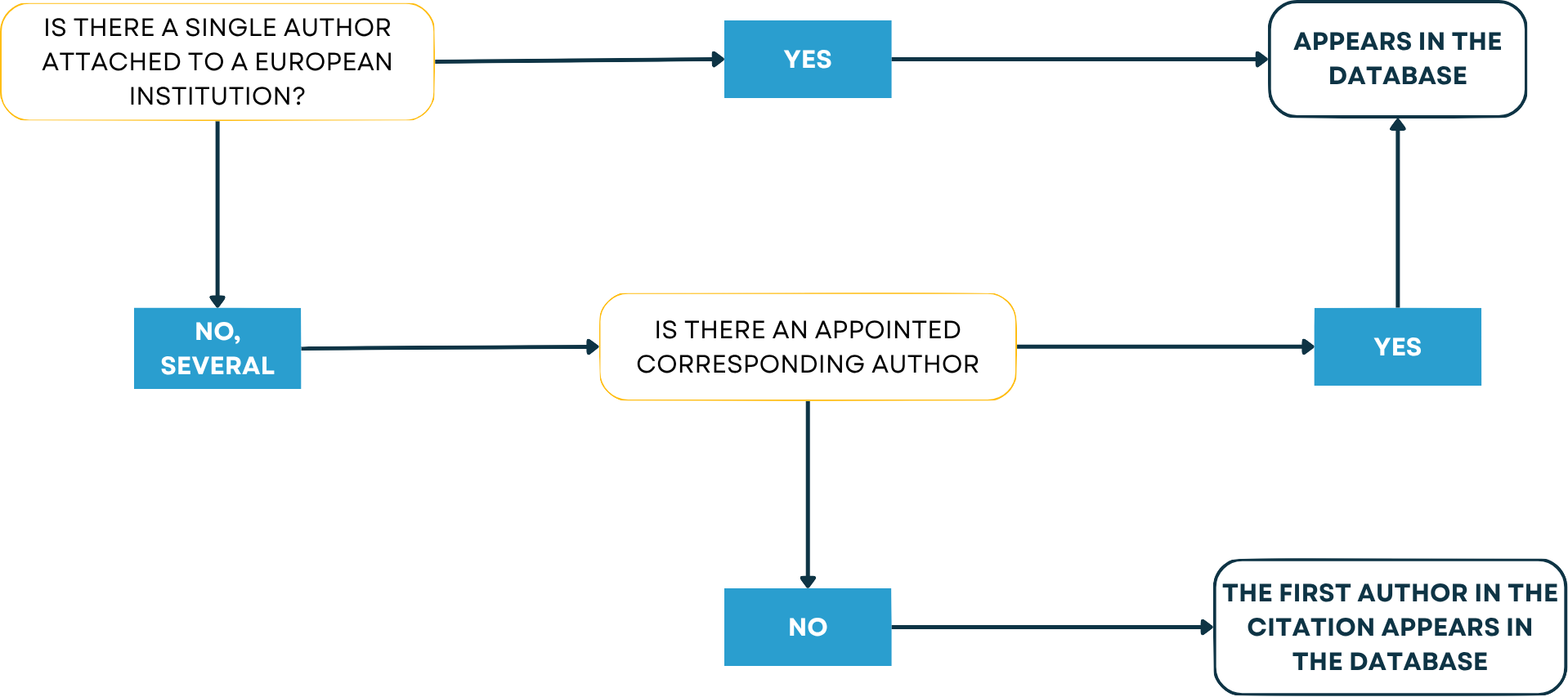
Why is there only one of the co-authors of the article in the database?
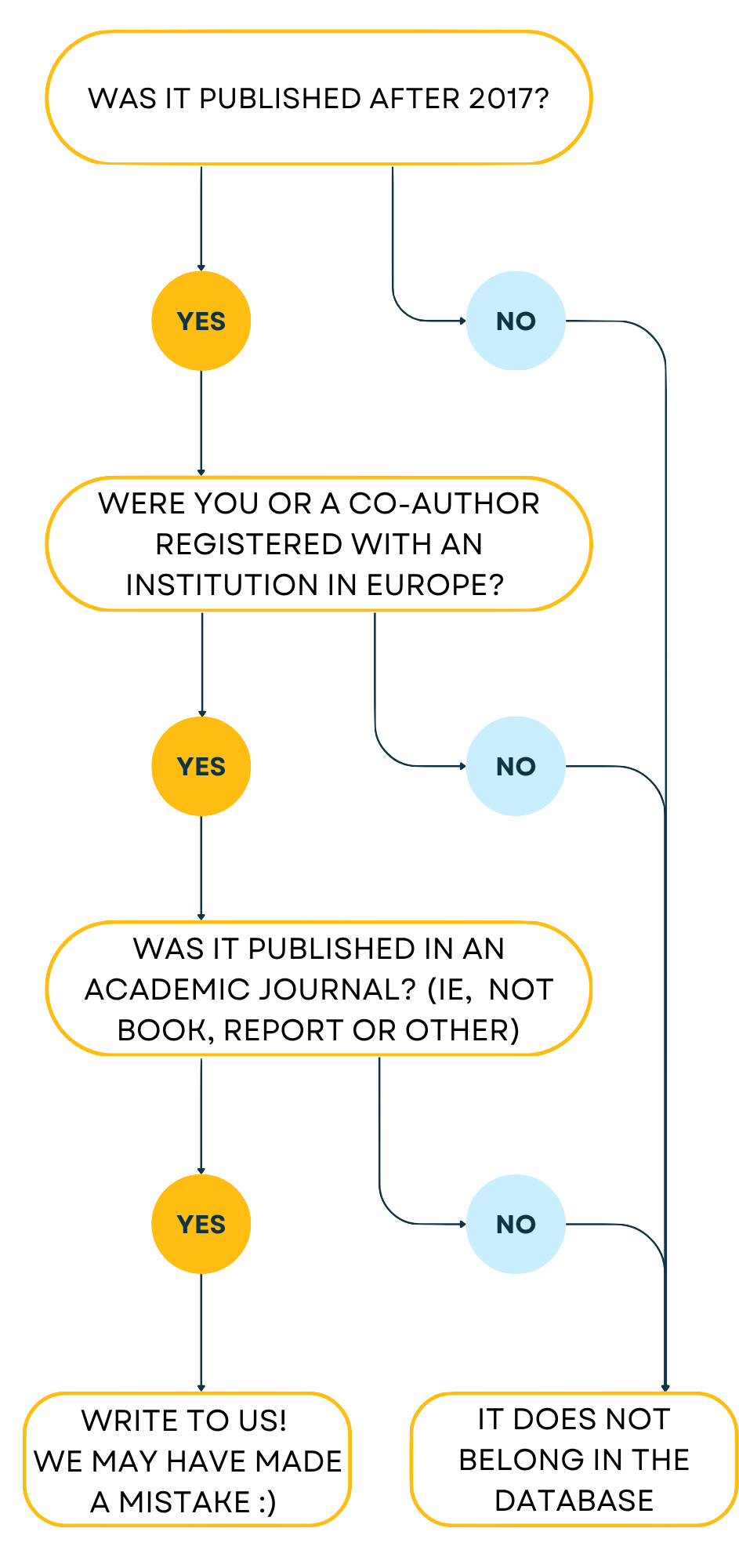 Regrettably, we cannot feature multiple authors for a single article in the database without compromising the other filtering features. Thus, for articles by multiple authors the name which appears in the database was chosen on the following basis - click on the image to enlarge.
How did you define “European publications”?
The English database is restricted to articles published by Europe-based scholars, ie, authors registered at an institution in Europe. The French and German databases are not limited to Europe-based authors but articles published in these two ‘European’ languages.
Why so few German sources?
It appears that materials on these topics published in German are predominantly books, book chapters or other study publications, thus limiting the German entries in this database which is restricted to research articles published in academic journals. Germanophone scholars most likely prioritise publishing research articles in English.
How does the volume of European publications on Chinese party-state politics compare to other research hubs?
From the research process, we estimate the pool of articles from authors based in the US and Mainland/Hong Kong/Taiwan to be two- to threefold the size of European articles. In other words, these insights represent 200 “European-written” articles, whereas the majority of research articles published on the topic appear to be by scholars in the US and China.
Why the drop in volume since 2023?
Simply put, we don’t know - but here are a couple of hypotheses.
- Difficulty accessing primary sources following the Covid-19 pandemic:
- Since coming out of lockdowns, some scholars have experienced more reticence from potential interviewees to express themselves openly about the Chinese political system, including for research purposes. Therewith, documentation from the CCP also gets removed more frequently from previously available databases (as per the Policy Documents database)
- Loss of academic research interest on Party-State topics:
- Many articles continue to be published on other themes related to China but there may be a satiety among European scholars for that particular field of Party-State research, or that those who do cover it adequately fill remaining literary gaps. In this vein, the research trend may just have moved on to another China-topic to be in vogue.
Please keep in mind this database only catalogues research articles published by authors based in Europe and in making we found a larger number of articles published by authors located in the US, Mainland China, Hong Kong and Taiwan. The drop in volume since 2023 is therefore a primarily European observation that does not necessarily pertain to other research hubs.